How to Program Transmission Control Module Safely and Correctly
A transmission control module, or TCM, manages important decisions such as shift timing, clutch pressure, torque-converter operation, and communication with the engine computer. When the module is replaced, updated, or installed in another vehicle, it may need programming before the transmission can operate correctly. Symptoms of an unprogrammed or incorrectly configured module can include warning lights, harsh shifting, no-drive conditions, or a vehicle that will not communicate with the transmission system.
Programming is not the same as clearing trouble codes or performing a transmission relearn. It usually requires a vehicle-specific scan tool, the correct calibration file, stable battery voltage, and access to manufacturer software. The safest realistic method for a beginner is to identify the exact vehicle and module, then use an approved factory scan tool or a reputable repair facility with the required programming access.
This guide explains how to program transmission control module software without guessing, damaging a module, or interrupting the writing process. You will learn how to confirm compatibility, prepare the vehicle, transfer the calibration, complete setup procedures, and check the result with diagnostic and road tests. If the module is not communicating, the vehicle cannot maintain voltage, or the required software is unavailable, stop before programming and arrange qualified diagnostic help.
At a glance
- Programming requires exact vehicle and module compatibility, not just a similar part number.
- Stable battery voltage and uninterrupted scan-tool communication are essential during the software write.
- A successful programming session still requires clearing faults, configuration, relearn procedures, and a careful verification drive.
How to program transmission control module software safely
The procedure below describes the general factory-style process. Menu names differ among manufacturers, and some vehicles combine transmission programming with immobilizer, body-control, or engine-module setup. Use the vehicle’s service information as the final authority rather than selecting a calibration based only on year, engine size, or a visual resemblance.
Tools you will need
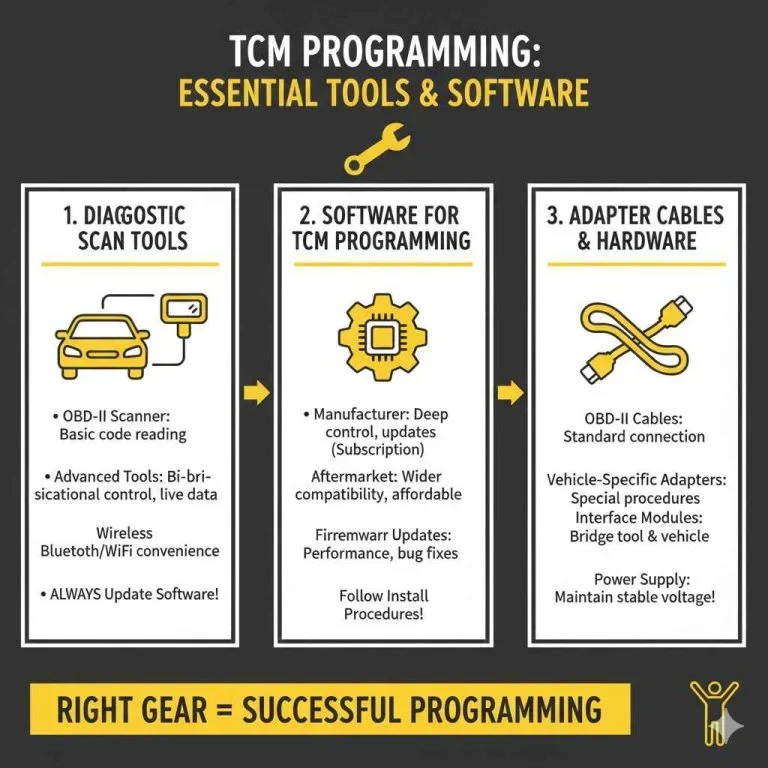
- An approved factory scan tool or supported J2534 pass-through device for module programming
- A computer with the manufacturer’s current programming application and an active subscription, when required
- A regulated battery maintainer or programming power supply that meets the vehicle manufacturer’s voltage requirements
- The vehicle identification number and the TCM part number or replacement information
- Optional: a second scan tool or diagnostic interface for confirming codes after programming

Step 1 Identify the vehicle and the exact transmission module
Record the vehicle identification number, model year, engine, transmission type, drive layout, and any module identification numbers before connecting a programming tool. If the TCM has already been replaced, photograph or write down its label, hardware number, software number, and connector arrangement.
Check the manufacturer’s parts catalog and service information to confirm that the module is correct for this vehicle. A module from the same model family may still contain incompatible hardware, regional programming, gear-ratio settings, emissions configuration, or communication software. The scan tool should be able to identify the vehicle and display the existing module, or the replacement documentation should clearly confirm compatibility.
Do not proceed if the part number is uncertain, the module is for a different transmission, or the replacement was sold as “universal” without a manufacturer-approved application list. Programming cannot correct a physically incompatible module.
Step 2 Check the vehicle’s electrical and communication condition
Inspect the battery terminals, main grounds, fuses, and the diagnostic connector. Connect the scan tool and perform a full vehicle scan before attempting to write software. Save the diagnostic trouble codes and module information so you have a record of the original condition.
Pay particular attention to low-voltage codes, lost-communication codes, ignition-feed faults, and network faults involving the controller area network, commonly called CAN. A TCM that cannot communicate may have a power, ground, wiring, connector, or network problem rather than a programming problem.
Connect the battery maintainer or programming power supply according to its instructions. Turn off lights, climate controls, audio equipment, phone chargers, and accessories. The vehicle should remain in the required key position, usually with the ignition on and the engine off, unless the software specifically instructs otherwise.
Important
Do not disconnect the battery, unplug the scan tool, turn the ignition off, or start the engine while software is being written. An interrupted programming session can leave the TCM in an incomplete state and may require professional recovery or module replacement.
Step 3 Confirm software access and select the correct programming function
Open the manufacturer’s programming application or the factory scan-tool software. Enter the vehicle identification number when prompted, then select the transmission control module and the programming, reprogramming, or software-update function. Some tools first perform an automatic vehicle identification; verify that the displayed vehicle matches the one in front of you.
Review the listed calibration or software description before accepting it. The correct file may depend on transmission code, engine, axle ratio, emissions certification, market, build date, and existing module configuration. Follow any prompts for entering the original module information or transferring configuration data from the old controller.
If the tool reports that no calibration is available, the module is not supported, or the vehicle cannot be identified, do not choose a file from a similar vehicle. Confirm the subscription, communication interface, module part number, and service-information requirements instead.
Step 4 Save configuration data and begin the software transfer
Use the scan tool’s backup, identification, or configuration function if available. Depending on the vehicle, the stored information may include learned values, vehicle options, tire-size settings, transmission type, security data, or other coding required by the replacement module. A useful way to approach how to program transmission control module is to check your progress after each stage.
Start the programming operation only after the tool shows the correct vehicle and module. Keep the scan tool connected directly as required by the manufacturer; avoid wireless connections when the programming system specifies a wired interface. Watch the status messages and do not operate other applications on a programming laptop during the transfer.
The display may show several stages, such as erasing, downloading, writing, verifying, or restarting the module. The screen can appear inactive while the controller resets, so follow the tool’s instructions instead of assuming the process has stopped. If an error appears, record the exact message before retrying.
Step 5 Complete setup, coding, and required relearn procedures
After the calibration transfer finishes, allow the scan tool to complete any requested key cycles or module resets. Some vehicles require a separate configuration step to write vehicle options into the TCM. Others require security authorization or communication with a gateway module before the controller will operate normally.
Clear only the codes the programming instructions identify as expected. Then perform the required initialization or transmission relearn procedure. A relearn teaches the controller how the transmission, solenoids, clutch packs, and sensors behave in that particular vehicle; it does not replace the software programming process.
The relearn may be a stationary procedure, a controlled series of shifts, or a specific road test. Follow the service information exactly. If the procedure requires a certain fluid temperature, speed range, throttle position, or gear selection, do not improvise.
Step 6 Verify communication and perform a controlled road test
Turn the ignition off and back on as directed, then rescan every module. Confirm that the TCM has an identification number, current software or calibration information, and no active programming or communication fault. Check that the transmission range display agrees with the shifter position and that the vehicle starts only in the intended ranges.
Before driving, inspect for warning lights, fluid leaks, loose connectors, and unusual noises. Begin in a safe area with light throttle. Confirm reverse engagement, forward engagement, upshifts, downshifts, torque-converter operation, and the absence of severe slipping, banging, or delayed engagement.
Some shift firmness or timing changes during the first drive can be normal while adaptive values are being relearned. However, a flashing transmission warning, loss of drive, harsh engagement that does not improve, or a new fault code is a reason to stop driving and diagnose the cause.
Check your result
A successful result is more than “programming complete” on the screen: the TCM identifies correctly, communicates without active faults, completes its required setup, and operates the transmission normally during a cautious test drive.
What TCM programming actually changes
Programming installs or updates the software and calibration that tell the controller how to operate the transmission. The calibration can contain shift schedules, pressure commands, torque-management requests, sensor interpretation, diagnostic thresholds, and compatibility information for the engine and vehicle network.
The TCM may also be called a transmission control unit or, on some vehicles, part of an integrated powertrain control module. The name matters less than identifying which controller the manufacturer says must be updated. A factory scan tool can usually display the module name and current calibration identifiers.
Understanding how to program transmission control module also means recognizing the limits of the method.
Programming versus relearning
Programming changes the controller’s installed software. Relearning resets or updates adaptive values that the controller uses to compensate for clutch wear, solenoid response, and transmission behavior. A newly programmed module may need both, but they are separate operations.
Clearing trouble codes is a third, different action. It removes stored diagnostic information but does not install software or repair a wiring, sensor, hydraulic, or mechanical fault. If a code returns immediately after clearing, investigate its cause rather than repeatedly erasing it.
Why stable voltage matters
During programming, the vehicle may keep multiple modules awake while the scan tool communicates with them. Voltage that drops too low can interrupt the transfer, while an unsuitable charger can create electrical noise or voltage spikes. Use the power-supply type and voltage range specified by the manufacturer or programming equipment.
A normal battery charger is not automatically a programming power supply. If the battery is weak, replace or properly charge it before the session, then connect the approved maintainer. Do not rely on the engine running to support programming unless the service procedure explicitly requires it.
How to confirm the programming worked
Verification should combine scan-tool information with vehicle behavior. A message saying that the download finished confirms only that the tool reported completion; it does not prove that the module is correctly configured or that the original fault has been repaired.

- Confirm the TCM is visible on a full vehicle scan.
- Compare the installed calibration or software number with the intended update.
- Check for current communication, voltage, sensor, and transmission codes.
- Confirm that range selection and gear-position data are accurate.
- Perform any manufacturer-specified initialization or adaptive relearn.
- Check transmission fluid level and condition using the correct procedure for the vehicle.
- Road-test gently, then rescan for codes and review relevant data if the scan tool supports it.
If the transmission still shifts poorly after correct programming, the problem may involve fluid level, internal wear, a valve body, solenoid, speed sensor, wiring, power supply, or a different control module. Programming a replacement controller does not repair mechanical damage.
Common problems and safer next actions
The table below separates programming symptoms from conditions that should be diagnosed before another attempt. Repeating the same failed download can make recovery more difficult.
| What you observe | Reasonable next check |
|---|---|
| The tool cannot communicate with the TCM | Check battery voltage, fuses, grounds, connector pins, ignition feeds, CAN wiring, and whether the module is the correct part. |
| The tool rejects the calibration | Verify VIN, transmission code, region, hardware number, software subscription, and programming-device support. |
| Programming stops or reports low voltage | Stop, stabilize the power supply, record the error, and follow the manufacturer’s recovery procedure. |
| Programming completes but codes return | Read the exact code and test its circuit or system; do not assume another software write will fix it. |
| Shifting is harsh after programming | Confirm fluid level, required relearn, sensor data, and whether the harshness is present in all gears. |
When to stop and seek qualified help
Stop if the vehicle loses communication with several modules, the scan tool reports a security or gateway failure, the TCM becomes unresponsive, or the programming process is interrupted. A qualified technician may have recovery software, wiring test equipment, a stable programming power supply, and access to module replacement or bench-programming procedures.
Professional help is also the sensible choice when the vehicle is needed for immediate transportation, when the module is used or unknown, or when the transmission has no drive. Do not road-test a vehicle that cannot select a gear reliably or has a severe leak.
Frequently asked questions
Can I program a TCM with an inexpensive code reader?
Usually not. Basic code readers generally read and clear faults, while programming requires a supported factory scan tool or J2534 pass-through device, manufacturer software, and appropriate access.
Does replacing a TCM always require programming?
Many modern vehicles require programming, configuration, security authorization, or a relearn after replacement. The exact requirement depends on the vehicle and module design, so verify it in the manufacturer’s service information.
Can I program the module without the original TCM?
Sometimes. A new module may be configured from the vehicle identification number and replacement-module data, but some vehicles need information transferred from the original controller. If the original module is unavailable or damaged, a dealer or qualified specialist may need to perform additional setup.
Will programming fix harsh shifting?
It can correct a software-related shift issue, but harsh shifting can also result from low or incorrect fluid, electrical faults, solenoid problems, hydraulic wear, or internal transmission damage. Diagnose returning codes and physical symptoms before assuming software is the cause.
Can low battery voltage damage the TCM during programming?
Low voltage can interrupt the software write and leave the module incomplete or unresponsive. Use a suitable regulated power supply and postpone the procedure if the battery, wiring, or charging system cannot maintain the required voltage.
Finish with a verified transmission controller
Learning how to program transmission control module software is mainly an exercise in correct identification, stable power, uninterrupted communication, and exact manufacturer procedures. The safest process is to confirm the module and calibration first, use supported equipment, complete configuration and relearn functions, and verify the result with both a scan and a controlled road test.
If the tool cannot communicate, the calibration does not match, or the vehicle develops serious shifting or network problems, stop rather than guessing. A qualified repair facility can determine whether the remaining issue is software, wiring, hydraulics, or internal transmission damage and can recover a controller when a failed programming attempt has left it incomplete.