
What Part of a Tire Cannot Be Patched: Complete Guide and Tips
A tire’s sidewall, shoulder, and bead area generally cannot be safely patched. Damage outside the central tread repair zone usually requires tire replacement.
When a tire goes flat, the timing of the decision matters. A quick plug may seem convenient, but driving even a short distance on low pressure can create hidden internal damage that changes a simple puncture into an unsafe tire. The visible hole is not always the most important problem.
Knowing what part of a tire cannot be patched helps you avoid repairs that look successful but fail under heat speed or load The central tread is sometimes.
- ✓The sidewall, shoulder, and bead are normally not safe areas for a permanent puncture repair.
- ✓A repairable puncture is usually small, straight, and located in the central tread—not near the tread edge.
- ✓Driving on a flat or severely underinflated tire can cause internal damage that cannot be seen from outside.
- ✓A tire should be removed and inspected from the inside before a proper patch-and-plug repair.
- ✓When damage reaches cords, creates a bulge, or involves a cut or separation, replacement is the safer choice.
What Part of a Tire Cannot Be Patched?
The parts of a tire that generally cannot be safely patched are the sidewall, shoulder, bead, and areas beyond the repairable central tread zone. These sections flex differently from the tread and are responsible for important structural functions, so a repair material may not remain secure as the tire bends, heats, and carries the vehicle’s weight.
The sidewall is especially important because it flexes continuously while the vehicle moves. It contains cords and rubber designed to withstand repeated deformation, but it is not a stable surface for a puncture repair. A patch placed there can peel away, stretch, or fail to restore the tire’s original strength.
The shoulder is the curved transition between the tread and sidewall. Even when a puncture appears close to the tread, its position may place it in this high-flex area. Tire technicians often treat damage near the shoulder as nonrepairable because the repair would not remain within the tire’s strongest, most stable section.
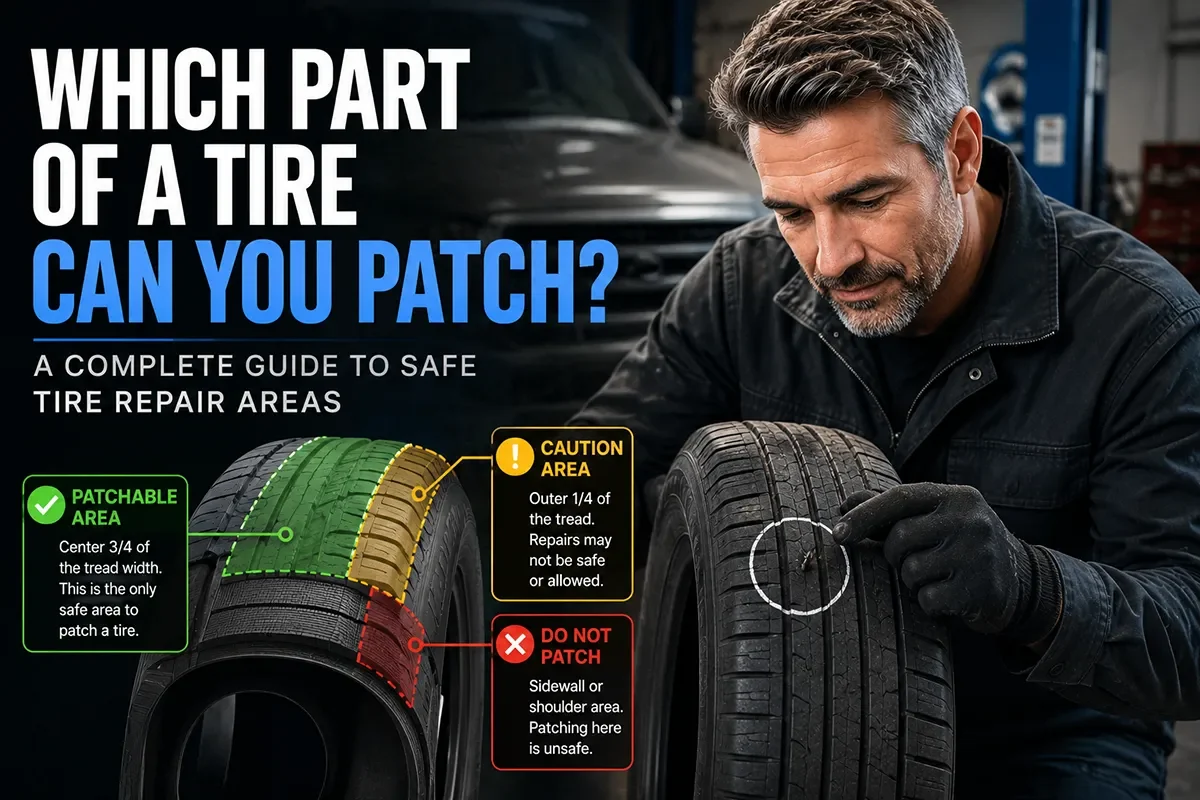
- Sidewall damage: Punctures, cuts, slices, and bulges in the sidewall normally require replacement.
- Shoulder damage: A hole near the outer tread ribs may flex too much for a dependable repair.
- Bead damage: Damage where the tire seals against the wheel can cause air loss and unsafe seating.
- Internal damage: Broken cords, separations, or abrasion cannot be restored with an exterior patch.
Why the sidewall is different
The sidewall is not simply a decorative strip between the tread and wheel. It supports the vehicle while allowing the tire to flex over bumps, during turns, and under braking. That constant movement places unusual stress on any repair installed in the area.
A tread repair benefits from the thicker, more stable rubber and reinforcement in the footprint that contacts the road. A sidewall repair does not have the same conditions. Even if the hole stops leaking at first, the repaired area may weaken as the sidewall repeatedly bends.
Why a bulge is more serious than a puncture
A bulge or bubble usually indicates that the tire’s internal cords have been damaged. This can happen after striking a pothole, curb, road edge, or other object. The outer rubber may remain mostly intact, but the internal reinforcement may no longer contain air pressure properly.
A patch can seal a hole; it cannot rebuild broken body cords. A visible bulge is therefore a replacement warning, not a repair opportunity. Do not continue driving on a tire with a growing bubble, exposed cord, or distorted sidewall.
Why Puncture Location Determines Repairability
A tire’s tread is strongest in the area that sits between the major grooves and remains flat against the road. This central zone is commonly called the repairable tread area. A small puncture in that region may be repairable if the tire meets other safety conditions.
As the puncture moves toward the outer tread rib, the tire begins to curve into the shoulder. That curved area flexes more and receives different forces during cornering. The difference between a repairable tread puncture and a nonrepairable shoulder puncture may be only a small distance, which is why visual judgment from a standing position can be unreliable.
For the same reason, the angle and shape of the injury matter. A narrow object that enters straight through the tread may leave a suitable repair path. A screw driven at an angle, a torn opening, or a long cut may damage several internal components even if the entry point appears to be in the center.
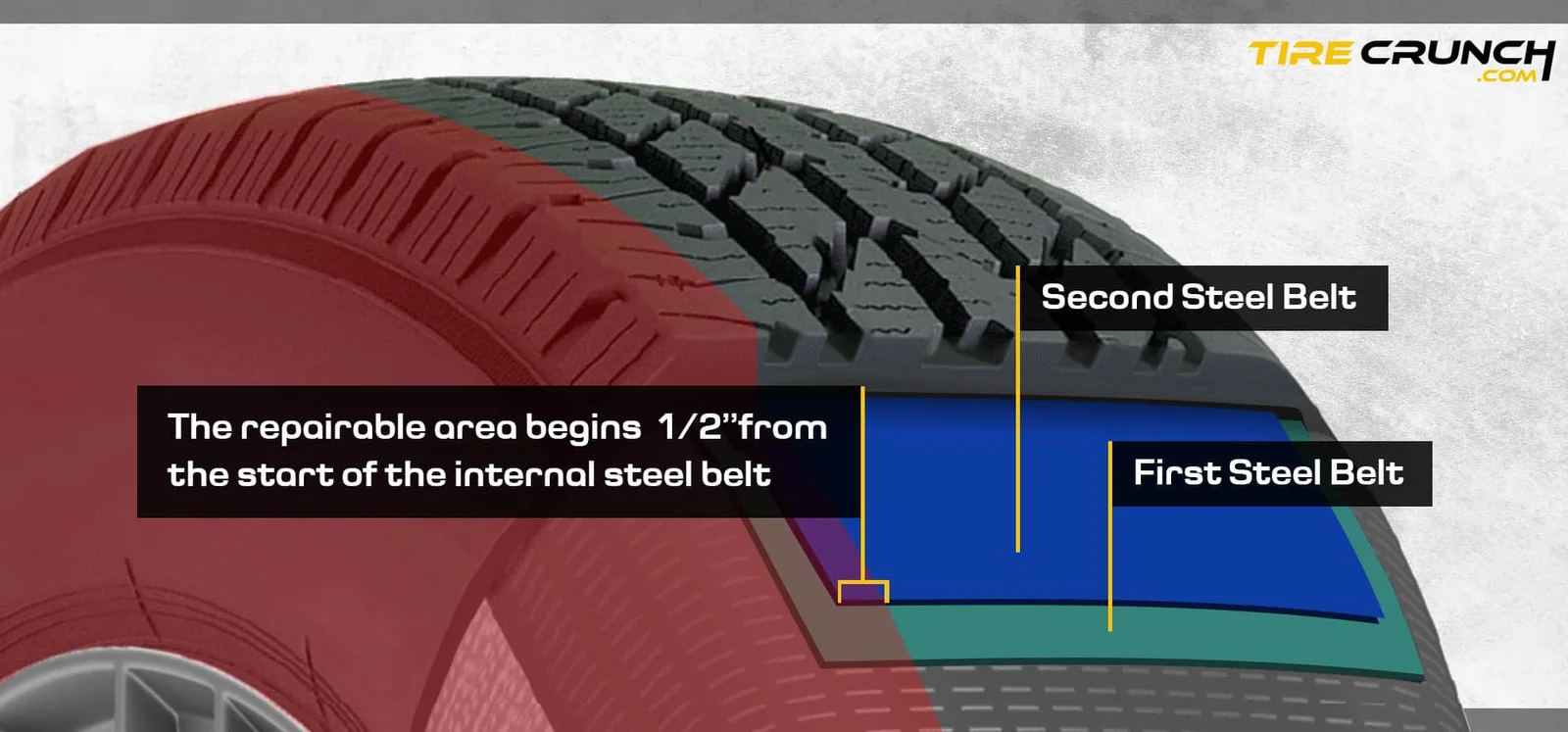
- Entry location: Confirm whether the injury is in the central tread or close to the shoulder curve.
- Injury shape: A clean, small puncture is different from a slit, tear, or ragged opening.
- Entry angle: Angled damage can create a longer internal channel than the surface suggests.
- Remaining tread: A worn tire may not be a good repair candidate even when the puncture location is acceptable.
The central tread zone
The center tread is the area most likely to qualify for repair because it has relatively stable rubber and reinforcement. However, “central tread” does not automatically mean “safe to patch.” A technician must still check the puncture size, internal condition, tire age and wear, and whether the tire was driven while underinflated.
The repair must also be installed correctly. A proper repair generally involves removing the tire, locating all internal damage, preparing the injury channel, and using a combination repair unit that seals the puncture and bonds to the inner liner. An external plug alone may stop a leak temporarily but does not provide the same inspection or sealing process.
Outer tread and shoulder overlap
The outer tread ribs can be confusing because they still look like tread blocks. The key issue is not only whether the hole is in a tread groove or block; it is whether the injury lies in the portion of the tire that begins to curve and flex toward the sidewall.
If a puncture is close to the edge of the tread, a technician may decline the repair even when the tire is not visibly leaking quickly. This conservative decision protects against a repair that sits in a high-stress area and fails later.
How to Tell Whether a Tire Injury Is Repairable
Determining what part of a tire cannot be patched is only the first step. A tire in the correct location can still be unsafe to repair because of internal damage, excessive injury size, poor condition, or a history of being driven flat.
A professional inspection should begin with the tire still inflated when possible, followed by removal from the wheel for an interior examination. The technician should inspect the inner liner for abrasion, rubber dust, wrinkles, exposed cords, and signs that the tire was operated without enough air. Those clues can reveal damage that the outside does not show.
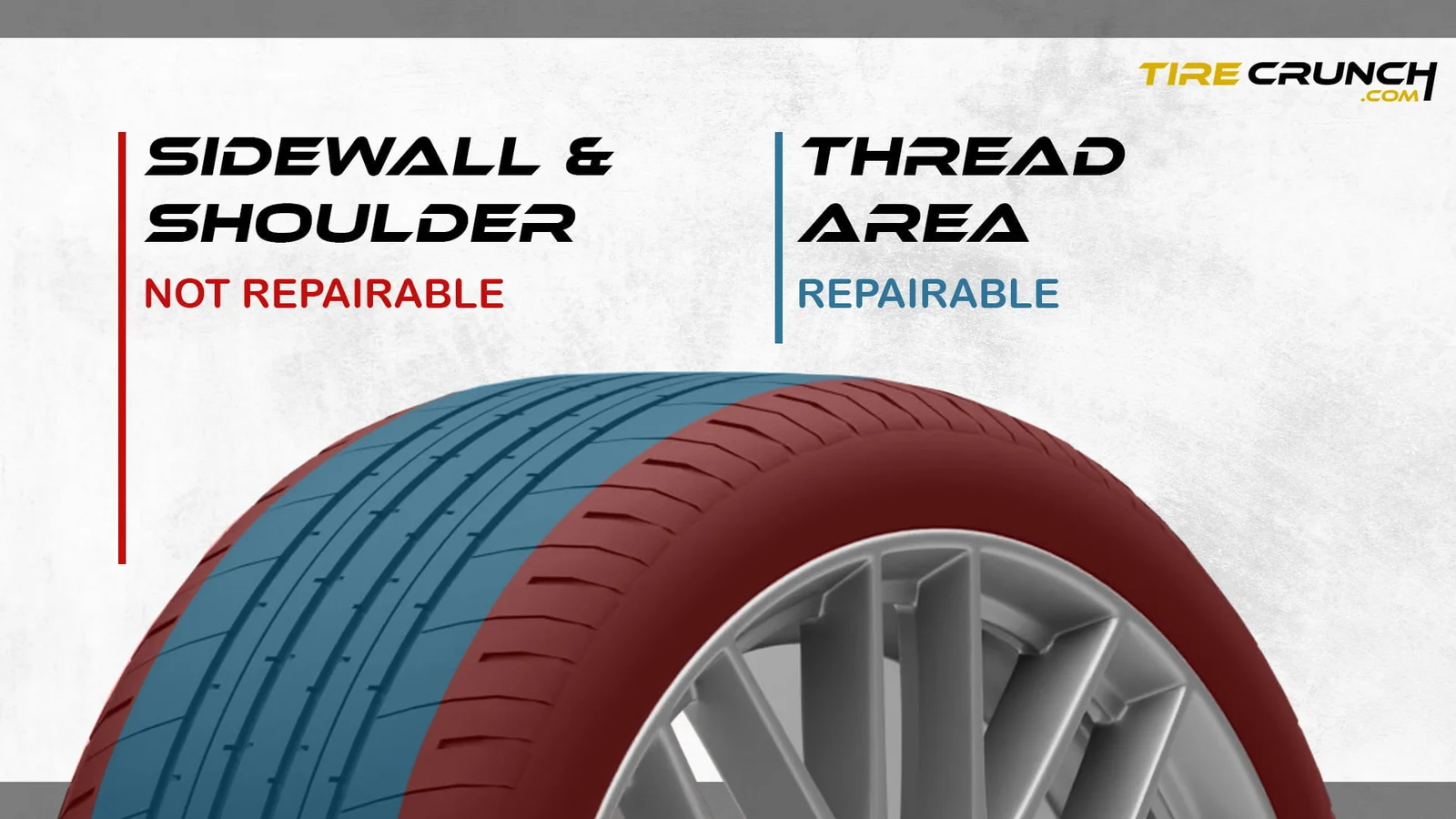
- Location: Is the injury clearly inside the central tread repair zone?
- Condition: Is the tire free from bulges, cuts, separations, exposed cords, and severe cracking?
- History: Was the tire driven after it lost pressure or while visibly flat?
- Repair count: Are previous repairs properly spaced and away from one another?
Size and type of injury
Small, round punctures are more promising repair candidates than long cuts or torn openings. The exact allowable size depends on the tire, repair policy, and professional guidance, so the technician should measure rather than guess. A hole enlarged by a tire-changing tool or an object that entered at an angle may be more serious than it appears.
A puncture that passes through the tread can damage steel belts, textile cords, or the inner liner. If those components are cut, separated, or distorted, sealing the surface does not restore the tire’s load-carrying structure.
Evidence of driving while flat
Driving on a deflated tire can pinch the sidewall against the wheel and cause internal abrasion. Common signs include a circumferential scuff or a pile of rubber dust inside the tire. The exterior may look acceptable after the tire is inflated, which is why an internal inspection matters.
Even a short trip can matter if the tire was carrying the vehicle’s weight without sufficient air. Speed, load, road temperature, and distance all influence the severity. If you know the tire was driven flat, tell the technician instead of treating it as an ordinary puncture.
This distinction matters when answering “what part of a tire cannot be patched”.
Existing repairs and tread condition
Multiple repairs can weaken the decision to repair again, particularly when they are close together or overlap. A repair should not be used to cover another damaged area, and a tire with a questionable previous plug may need replacement rather than another patch.
Worn tread, irregular wear, dry rot, and age-related cracking also affect the decision. Repairing one puncture does not make a tire with broader deterioration suitable for continued use.
Patch, Plug, and Patch-Plug Repairs
People often use patch to describe every puncture fix but plugs and patches work differently A plug is inserted through the injury from the outside A patch is.
An outside plug may be useful as a temporary measure in an emergency, but it does not allow a complete internal inspection. It can also fail to seal the puncture channel along its full length. A plug should not be treated as proof that the tire is permanently safe.
| Repair type | What it does | Main limitation |
|---|---|---|
| Exterior plug | Fills a puncture from the outside and may slow or stop air loss | Does not inspect or fully seal the inner liner |
| Interior patch | Seals the inside surface after the tire is removed | May not fill the entire puncture channel by itself |
| Combination repair | Seals the channel and bonds to the inner liner | Only appropriate for qualifying injuries in suitable locations |
- Leaving a plug forever: A temporary roadside fix should be professionally inspected as soon as possible.
- Repairing without dismounting: The inside may contain damage that cannot be found from the tread surface.
- Using a patch on the sidewall: A patch cannot restore the sidewall’s damaged cords or flexing strength.
Why an inside-out repair is preferred
Removing the tire lets a technician inspect the puncture path, clean and prepare the inner liner, and check whether the tire suffered run-flat damage. It also confirms whether a previous repair is interfering with the new one.
This process takes more time than inserting a plug, but the extra inspection is part of the safety benefit. A repair that is inexpensive because no one looked inside may become expensive if it fails or masks a larger structural problem.
Damage That Requires Tire Replacement
Some injuries are clearly beyond repair. Replacement is normally necessary when the tire has a sidewall puncture, shoulder cut, bead damage, exposed cords, a bulge, tread separation, or severe internal abrasion. A tire with widespread cracking or a distorted carcass also should not be returned to service simply because it still holds air.
Replacement is also the safer choice when the tire has been driven extensively while flat, when the injury is too large or irregular, or when several repairs compromise the same section. A tire can lose air slowly and still have structural damage that makes continued use unsafe.
- Visible bulge or bubble: Indicates possible internal cord failure.
- Sidewall slice or puncture: The flexing sidewall cannot be reliably restored with a patch.
- Bead or rim-seat damage: The tire may not maintain a dependable seal on the wheel.
- Separation: A raised tread section, vibration, or irregular belt movement can signal internal failure.
Sidewall scuffs versus sidewall cuts
Not every mark on a sidewall has the same meaning. A light surface scuff may be cosmetic, while a deep cut, abrasion that exposes cords, or a localized bulge is structural. Because the distinction can be difficult to make without experience, questionable damage deserves a professional inspection.
Do not confuse raised lettering or normal molding marks with a bulge. A true bubble changes the tire’s contour and may become more obvious as pressure increases. It should never be pressed, punctured, or covered with a patch.
Bead and wheel-related problems
The bead is the reinforced edge that locks against the wheel and helps contain air. Damage here can result from mounting equipment, a bent wheel, corrosion, or driving with very low pressure. A repair to the visible rubber may not correct a damaged bead wire or a wheel that cannot provide a smooth sealing surface.
If a replacement tire repeatedly loses air near the rim, the cause may be a bent wheel, corrosion, valve problem, or bead-seat issue rather than a simple tread puncture. Repairing the wrong component will not solve the leak.
What to Do After Finding a Puncture
When you notice a warning light soft handling vibration or a visible object in the tread reduce risk before examining the tire Avoid pulling out a nail or screw immediately because it may.
Do not rely on a tire-pressure monitoring system as a substitute for inspection. The system may warn after pressure has already fallen, and it may not identify a sidewall injury or internal failure. Check pressure with a gauge when the tire is cold and follow the vehicle placard for the correct inflation pressure.
- Control the vehicle: Slow down smoothly, avoid hard steering, and stop somewhere away from traffic.
- Inspect without taking risks: Look for a puncture, sidewall bulge, cut, or tire that is visibly flat.
- Use the proper backup: Install the spare according to the vehicle instructions or call for assistance.
- Request a full inspection: Ask whether the tire was removed and checked internally before repair.
- Confirm the result: After a repair or replacement, verify inflation pressure and check for continued air loss.
- Do not crawl beside traffic: Call for help if reaching the tire would expose you to moving vehicles.
- Do not drive on a flat: Even a short distance can destroy the inner liner and sidewall.
- Do not inflate a damaged tire blindly: A severely damaged tire may fail during inflation.
How to Avoid Future Tire Damage
Good tire maintenance cannot prevent every road hazard, but it can reduce the chance that a repairable puncture becomes a replacement. Correct inflation helps the tread contact the road evenly and reduces excessive sidewall flex. Underinflation also increases heat buildup and makes impact damage more likely.
Check pressure regularly, including before long trips and when temperatures change significantly. Use the pressure listed on the vehicle’s door-jamb placard or owner’s manual rather than the maximum pressure molded into the tire sidewall. Inspect tread and sidewalls for nails, cuts, cracks, bulges, and uneven wear.
- Pressure: Check all tires, including the spare, with a reliable gauge.
- Rotation: Follow the vehicle and tire manufacturer’s maintenance guidance to manage uneven wear.
- Alignment: Investigate pulling, steering-wheel position changes, or recurring edge wear.
- Impact damage: Inspect after striking a pothole or curb, especially if vibration begins afterward.
Why alignment and suspension matter
A tire that repeatedly wears on one edge may be affected by alignment or suspension problems. Those issues do not necessarily cause a puncture, but they reduce usable tread and can make the tire less suitable for repair after an injury.
Vibration after an impact may indicate a bent wheel, shifted belt, or other problem that a simple balance cannot correct. Have the assembly inspected before assuming the issue is only a lost wheel weight.
FAQ: What Part of a Tire Cannot Be Patched?
Can a tire sidewall puncture be patched?
A sidewall puncture generally cannot be safely patched for continued highway use. The sidewall flexes heavily, and a patch does not restore damaged cords or the tire’s original load-carrying strength.
Can a tire shoulder puncture be repaired?
A shoulder puncture is normally considered nonrepairable because it lies near the transition between tread and sidewall. This area flexes during cornering, so a repair may not remain secure.
Can a nail near the edge of the tread be patched?
Sometimes, but only if the injury is clearly within the repairable tread zone and the tire passes an internal inspection. If it is close enough to the shoulder that the tire curves around the injury, replacement may be required.
Can a tire with a sidewall bubble be repaired?
No. A bubble usually signals broken internal cords, and a patch cannot rebuild that structure. The tire should be replaced as soon as it can be done safely.
Can a tire be patched after driving flat?
It may be possible only if an internal inspection finds no damage, but driving flat commonly creates abrasion and heat damage inside the tire. If the inner liner is scuffed, wrinkled, or shedding rubber, replacement is necessary.
Is an exterior plug a permanent tire repair?
An exterior plug is generally treated as a temporary measure rather than a complete repair. A qualified technician should inspect the tire from the inside and determine whether a proper combination repair is suitable.
Can a tire bead be patched?
Bead damage is not normally repaired with a tread patch. The bead must seal securely against the wheel, so damage to the bead, bead wire, or wheel sealing surface may require tire or wheel replacement.
Conclusion
The sidewall, shoulder, bead, and any area with internal structural damage are the main answers to what part of a tire cannot be patched. A small puncture in the central tread may be repairable, but only after checking its location, size, angle, tire condition, and history of pressure loss.
When in doubt, do not judge the tire solely by whether it holds air. A professional internal inspection is the safest way to distinguish a legitimate repair from a temporary seal over damage that requires replacement.
Keep the tire inflated only if it can be done safely, avoid driving on it, and have a tire professional inspect the injury from the inside before choosing a repair.


