Can You Use a Truck Tent with a Tonneau Cover: Explained Clearly
The allure of truck camping is undeniable: the freedom of the open road, the convenience of a mobile basecamp, and the ability to explore off-grid locations. For many truck owners, a truck tent offers an ideal solution, transforming the truck bed into a comfortable sleeping area. However, a common accessory that often complicates this vision is the tonneau cover. These covers, designed to protect cargo and improve aerodynamics, occupy the very space a truck tent needs.
It’s a frequent point of confusion and a question I encounter regularly: can you use a truck tent with a tonneau cover? The simple answer is not a straightforward yes or no, as the compatibility depends heavily on the specific types of both the truck tent and the tonneau cover you own or are considering. Understanding the nuances of their designs and how they interact is crucial for making an informed decision.
This article will delve into the various types of truck tents and tonneau covers, explaining their mechanisms and how these impact their ability to coexist. I’ll guide you through the compatibility factors, potential challenges, and offer practical solutions and alternatives to help you achieve your truck camping goals, even if you prefer to keep your tonneau cover.
By the end of this comprehensive explanation, you’ll have a clear understanding of what works, what doesn’t, and what considerations are most important when trying to combine these two popular truck accessories for your next adventure.
Understanding Truck Tents and Tonneau Covers
Before diving into compatibility, it’s essential to understand the fundamental designs and purposes of both truck tents and tonneau covers. Their individual characteristics dictate how they might, or might not, work together.
What is a Truck Tent?
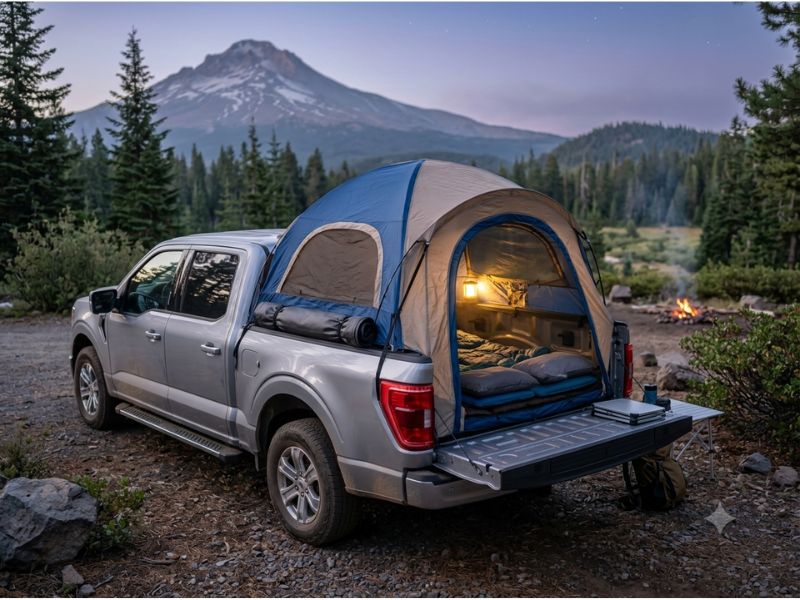
A truck tent is a portable shelter specifically designed to fit into the bed of a pickup truck. It typically features a floor that rests on the truck bed, walls that extend upwards, and a roof, much like a traditional ground tent. The main advantage is that it elevates your sleeping area off the cold, damp ground, provides a level surface, and keeps you away from critters. Most truck tents are designed to utilize the entire perimeter of the truck bed rails for support and sealing.
Common Types of Truck Tents:
- Standard Truck Bed Tents: These are the most common type, designed to set up directly in the truck bed. They often have poles that create a frame, and the tent fabric stretches over it, attaching to the bed rails with straps or clips. They require the truck bed to be completely clear of obstructions.
- Truck Cap/Shell Tents: Less common, these are designed to fit inside an existing truck cap or shell, essentially turning the enclosed space into a more comfortable camping area. These are not what most people refer to when asking about “truck tents” in the context of tonneau covers, as the cap itself acts as the primary shelter.
- Over-the-Rail Tents: Some designs are made to drape over the bed rails, securing underneath, which can sometimes interfere with certain tonneau cover mounting systems.
What is a Tonneau Cover?
A tonneau cover, also known as a truck bed cover, is a protective cover that fits over the open bed of a pickup truck. Its primary purposes are to secure cargo from theft and weather, and in some cases, to improve fuel efficiency by reducing aerodynamic drag. Tonneau covers come in a wide variety of styles, each with different mounting mechanisms and operational methods.
Common Types of Tonneau Covers:
- Roll-Up Covers (Soft or Hard): These covers roll up towards the cab, either manually or sometimes with a spring assist. They typically mount to the inside of the bed rails, leaving the top surface of the rails free.
- Folding Covers (Soft or Hard): These covers consist of multiple panels that fold up towards the cab. Tri-fold covers are very popular. Like roll-ups, they often mount to the inside of the bed rails.
- Retractable Covers (Hard): These covers retract into a canister located at the front of the truck bed, near the cab. The canister itself takes up some bed space, and the rails for the cover usually sit on top of or slightly inside the bed rails.
- Hinged/One-Piece Covers (Hard): These are solid, single-piece covers that typically hinge at the front and lift up like a trunk lid. They often sit directly on top of the bed rails and require significant clearance to open.
- Toolbox/Crossover Covers: These combine a tonneau cover with a built-in toolbox near the cab. The cover typically rolls or folds over the remaining bed space.
Can You Use a Truck Tent with a Tonneau Cover? Exploring Compatibility
The core question of whether you can use a truck tent with a tonneau cover hinges on how each accessory occupies and utilizes the truck bed space, particularly the bed rails and the vertical clearance above the bed.
The Primary Conflict: Bed Rail Usage and Vertical Clearance
Most standard truck tents are designed to sit directly on the bed rails, using them as a foundation and sealing point. They often have straps or clamps that secure around or under the rails. Many tonneau covers, especially those that mount internally, also use the bed rails for their mounting rails or clamps. This creates a direct conflict: two accessories trying to occupy the same physical space on or immediately adjacent to the bed rails.
Furthermore, a truck tent needs the entire bed opening to be clear for setup and to provide its full internal volume. Many tonneau covers, when open, still have components that obstruct this space:
- Retractable covers have a canister at the front of the bed.
- Folding covers, even when fully folded, stack up at the front, reducing the usable length of the bed.
- Hinged covers, when open, extend high above the bed, potentially interfering with tent poles or fabric.
Compatibility by Tonneau Cover Type
Let’s break down the compatibility based on the type of tonneau cover you have or are considering.
1. Roll-Up Tonneau Covers (Soft or Hard)
- Compatibility: Generally, these offer the best chance of compatibility, especially soft roll-up covers.
- Why: Many roll-up covers mount with rails that sit inside the bed rails, leaving the top surface of the bed rails mostly clear. When rolled up, the cover typically forms a compact bundle near the cab, which might slightly reduce the effective length of the bed but often leaves enough room for a tent.
- Considerations:
- Mounting System: Check if your specific roll-up cover’s mounting clamps or rails interfere with where the truck tent needs to sit or clamp. Some tent designs might still conflict.
- Bundle Size: A bulky rolled-up cover might take up too much space at the front of the bed, making the tent feel cramped or preventing it from fully extending.
- Water Sealing: The tent’s seal against the bed rails might be compromised if the tonneau cover’s rails create an uneven surface.
2. Folding Tonneau Covers (Soft or Hard)
- Compatibility: Possible, but often with significant limitations.
- Why: Like roll-ups, many folding covers mount internally. However, when folded, they stack up into a much thicker and often longer bundle at the front of the bed compared to a rolled-up cover.
- Considerations:
- Reduced Bed Length: The folded cover can significantly reduce the usable length of your truck bed, potentially making a standard truck tent too long to fit comfortably or even at all.
- Mounting Interference: The clamps or rails for the folding cover can still interfere with the tent’s attachment points.
- Hard Folding Covers: These tend to be thicker when folded, exacerbating the length reduction issue.
3. Retractable Tonneau Covers (Hard)
- Compatibility: Generally poor, often incompatible.
- Why: Retractable covers have a large canister at the front of the truck bed where the cover stores when open. This canister permanently occupies a significant portion of the bed length (typically 10-15 inches).
- Considerations:
- Permanent Obstruction: The canister makes it impossible for most standard truck tents to fully extend and seal against the front bulkhead of the bed.
- Rail Interference: The rails for retractable covers usually sit on top of or very close to the bed rails, directly conflicting with where a truck tent needs to sit and seal.
- Specialized Tents: There are very few, if any, truck tents designed to work around a retractable tonneau cover’s canister.
4. Hinged/One-Piece Tonneau Covers (Hard)
- Compatibility: Highly unlikely, almost always incompatible.
- Why: These covers sit directly on top of the bed rails and are typically secured with clamps or hinges that are permanent fixtures. When open, they pivot upwards, often extending well above the cab.
- Considerations:
- Bed Rail Occupation: The cover completely occupies the bed rails, leaving no space for a truck tent to sit or seal.
- Opening Mechanism: Even if you could somehow fit a tent, the cover’s opening mechanism would interfere with the tent’s structure.
- Removal Required: To use a truck tent, you would almost certainly have to completely remove the hinged tonneau cover, which is often a two-person job and not practical for frequent use.
Key Factors for Compatibility Assessment
When trying to determine if your specific setup will work, consider these factors:
- Bed Rail Clearance: Does the tonneau cover’s mounting system leave the top surface and the inside lip of your truck bed rails mostly clear? This is where most truck tents need to sit and seal.
- Front Bed Obstruction: When the tonneau cover is fully open (rolled, folded, or retracted), how much of the front of the bed does it occupy? Will this reduce the usable bed length too much for your tent?
- Vertical Clearance: Does any part of the tonneau cover (e.g., a folded stack, a canister, or an open hinged cover) extend vertically in a way that would interfere with the tent’s poles or fabric?
- Tent Design: Some truck tents are more forgiving than others. Look for tents that have minimal bed rail intrusion or flexible attachment points.
- Waterproofing: Even if you can physically fit them together, will the combination create gaps that allow water to enter the tent?
Solutions and Alternatives for Truck Camping with a Tonneau Cover
If your current tonneau cover isn’t compatible with a standard truck tent, or if you’re looking for a solution that allows you to keep both, there are several approaches and alternative camping setups to consider.
1. Specialized Truck Tents Designed for Tonneau Covers
While rare, some manufacturers have developed truck tents specifically designed to work with certain types of tonneau covers. These are often tailored for roll-up or folding covers that leave the bed rails mostly clear when open.
- Features to look for:
- Internal Mounting: Tents that attach solely to the inside of the truck bed, rather than clamping over the rails.
- Adjustable Length: Tents with a more flexible design that can accommodate a slightly reduced bed length due to a folded or rolled-up cover.
- Integrated Sealing: Designs that account for the presence of tonneau cover rails for better weather sealing.
- Recommendation: Research specific tent models and check their compatibility lists. Contact the tent manufacturer directly with your tonneau cover’s make and model for the most accurate information.
2. Removing the Tonneau Cover (Temporary or Permanent)
This is the most straightforward solution, though not always the most convenient.
- Temporary Removal: For many roll-up and folding covers, it’s possible to temporarily remove the entire cover and its rails. This clears the bed completely for the truck tent.
- Pros: Guarantees full compatibility with any truck tent.
- Cons: Can be time-consuming, requires storage space for the cover, and might be a two-person job for heavier covers. Not ideal for frequent setup/takedown.
- Permanent Removal: If truck camping is a higher priority than cargo protection, you might consider removing the tonneau cover permanently.
3. Utilizing a Truck Rack System
A truck rack (also known as a bed rack or overland rack) offers an excellent solution for carrying camping gear, including tents, above the truck bed, often leaving the tonneau cover in place.
- Over-the-Tonneau Racks: Some rack systems are specifically designed to mount over certain types of tonneau covers (typically roll-up or retractable covers that have flush-mounted rails). These racks create a platform above the tonneau cover.
- Compatibility: Requires a tonneau cover that allows for compatible rack mounting. Many retractable covers, like those from Pace Edwards or Retrax, offer T-slot rails that integrate with specific rack systems.
- What to Mount: You can then mount a rooftop tent (RTT) to the rack, or even a ground tent that you store on the rack.
- Benefits:
- Keeps the truck bed free for storage, even with the tonneau cover closed.
- Allows for a rooftop tent, which offers different advantages than a truck bed tent.
- Maintains the security and weather protection of your tonneau cover.
- Considerations: Adds significant height to your truck, impacts aerodynamics, and can be a substantial investment.
4. Rooftop Tents (RTTs) on a Cab-Mounted or Bed-Mounted Rack
If you’re open to alternatives to a truck bed tent, a rooftop tent is a fantastic option that completely bypasses the tonneau cover conflict.
- Cab-Mounted Racks: A rack system installed over the truck’s cab allows you to mount an RTT there. This leaves the entire truck bed and tonneau cover completely untouched.
- Pros: Full use of the truck bed, tonneau cover remains functional.
- Cons: Higher center of gravity, can be harder to access the tent, potential for increased wind noise.
- Bed-Mounted Racks (above tonneau cover): As mentioned above, if you have a tonneau cover compatible with an over-the-tonneau rack, you can mount an RTT on that. This keeps the tent lower than a cab-mounted setup but still above the bed.
- Benefits of RTTs: Quick setup, comfortable mattress, off-the-ground sleeping, often very durable.
- Considerations: Higher cost than most truck bed tents, adds weight and height, requires a robust rack system.
5. Ground Tents or Other Camping Solutions
Sometimes, the simplest solution is to revert to traditional camping methods if the truck bed setup proves too challenging with your tonneau cover.
- Ground Tent: A conventional tent pitched on the ground next to your truck.
- Pros: No compatibility issues, often more spacious, can be set up anywhere.
- Cons: On the ground (cold, damp, critters), requires a level spot, takes up more space when packed.
- Truck Cap/Shell: If you don’t have one, installing a truck cap or shell effectively turns your truck bed into a secure, weather-protected sleeping area. You can then add a simple mattress inside.
- Pros: Excellent weather protection, secure, can be customized with lights, fans, etc.
- Cons: Permanent installation, significant upfront cost, reduces versatility for hauling tall items.
- Camper Shell/Slide-in Camper: For the ultimate truck camping experience, a dedicated camper shell or slide-in camper replaces the need for a tent entirely.
Making Your Decision: What to Consider
When weighing your options for combining a truck tent and a tonneau cover, or choosing an alternative, I recommend considering the following points:
1. Your Tonneau Cover’s Design
Start with what you already have. Is it a roll-up, folding, retractable, or hinged cover? This is the most critical factor in determining initial compatibility.
- Roll-up or Tri-fold (soft/hard): These offer the best chance of partial compatibility, but you’ll need to verify bed rail clearance and how much bed length is lost when the cover is open.
- Retractable or Hinged: These are almost universally incompatible with standard truck bed tents without removing the cover.
2. Your Truck Tent’s Design
If you’re buying a new tent, look for features that might aid compatibility.
- Internal Clamping: Tents that clamp to the inside of the bed walls rather than over the rails.
- Flexible Footprint: Tents that can adapt to a slightly shorter bed length.
- Specific Compatibility Claims: Some tent manufacturers explicitly state compatibility with certain tonneau cover types.
3. Frequency of Use and Convenience
How often will you be camping? How much effort are you willing to put into setup and takedown?
- Frequent Camper: If you camp often, a solution that requires minimal setup (like an RTT on a compatible rack or a truck cap) might be worth the investment.
- Occasional Camper: If it’s just a few times a year, temporarily removing a roll-up tonneau cover might be acceptable.
4. Budget
Costs vary widely across these solutions.
- Truck Bed Tent: Generally the most affordable tent option.
- Rooftop Tent: Significantly more expensive, plus the cost of a rack.
- Truck Cap/Camper: The highest investment.
5. Other Truck Usage Needs
Remember that your truck serves other purposes. Will your camping setup interfere with your daily hauling or work needs?
- Cargo Protection: If you frequently need to secure cargo, keeping your tonneau cover is important, pushing you towards rack-mounted RTTs or ground tents.
- Hauling Tall Items: A truck cap or RTT on a high rack might limit your ability to haul tall items.
6. Local Conditions and Environment
Consider where you’ll be camping.
- Cold/Wet Climates: A truck bed tent gets you off the ground. An RTT or truck cap offers even better insulation and protection.
- Uneven Terrain: A truck bed tent or RTT guarantees a level sleeping surface, unlike a ground tent.
Practical Tips for Maximizing Compatibility
If you’re determined to make a truck tent and tonneau cover work, here are some practical tips:
- Measure Everything: Before purchasing either, precisely measure your truck bed’s length, width, and especially the available space on the bed rails and the clearance when the tonneau cover is open.
- Research Specific Models: Don’t generalize. Look up reviews, forums, and manufacturer specifications for your exact truck, tonneau cover, and potential truck tent. Some tonneau covers are known to be more “tent-friendly” than others.
- Look for “Over-the-Rail” Tonneau Covers: Some older or less common tonneau covers mount completely over the bed rails, leaving the inside of the bed rails free. These might be more compatible with some truck tents. However, most modern covers mount internally.
- Consider Custom Modifications (with caution): For some minor interference, you might be able to make small, non-damaging modifications to a tent’s attachment straps or use shims to create a better seal. Always proceed with caution and ensure you don’t void warranties or compromise safety.
- Prioritize: Decide what’s more important to you: the tonneau cover’s benefits or the truck tent’s convenience. If one outweighs the other significantly, that will guide your decision.
Conclusion
The question of can you use a truck tent with a tonneau cover is one that many truck owners grapple with, and the answer is nuanced. While direct compatibility with standard truck bed tents is often challenging due to conflicting bed rail usage and space requirements, it’s not always impossible. Roll-up and certain folding tonneau covers offer the best chance of coexistence, though often with some compromise in bed length or setup convenience. For retractable and hinged covers, direct use with a truck tent is highly improbable without removing the cover entirely.
Fortunately, the world of truck camping offers numerous innovative solutions. From specialized tents designed for tonneau covers to robust truck rack systems that support rooftop tents, and even simple ground tents, there’s a way to enjoy the outdoors with your truck. By carefully evaluating your specific tonneau cover, understanding the design of different truck tents, and considering your camping habits and budget, you can find the perfect setup to transform your truck into a versatile adventure vehicle, even if it means exploring alternatives to a traditional truck bed tent.