Does a Tonneau Cover Improve Fuel Economy: Explained Clearly
Usually, yes—but only modestly, and not on every truck or in every driving situation. A tonneau cover can reduce aerodynamic drag over an open pickup bed, particularly at steady highway speeds, but the fuel savings are often small enough to be affected by wind, tires, payload, driving habits, and the cover’s design.
The basic idea is straightforward: air flowing over a pickup encounters the cab, drops into or circulates through the bed, and then separates behind the truck. That turbulent airflow creates drag. A properly fitted cover can smooth the transition behind the cab and keep air from repeatedly striking exposed cargo, bed walls, and the tailgate area.
It does not make the truck aerodynamic in the same way as a sedan, and it cannot eliminate the drag created by the truck’s height, frontal area, wheels, mirrors, and underbody.
This guide explains when a cover is most likely to help, why advertised fuel-economy gains vary, whether soft and hard designs perform differently, and how to test the result on your own truck. It also covers tailgate removal, bed extenders, cargo weight, installation problems, winter and towing considerations, cost-effectiveness, and the safety limits that matter more than a small change at the pump. By the end, you will be able to judge whether a tonneau cover is a sensible purchase for your driving pattern rather than treating fuel savings as a guarantee.
How a Tonneau Cover Can Affect Fuel Economy
A tonneau cover may improve fuel economy by reducing airflow disruption around the pickup bed. The improvement comes from lowering aerodynamic drag, which is the force resisting the truck as it moves through the air.
With an uncovered bed, air traveling over the cab can flow downward into the bed and collide with the bed floor, cargo, inner walls, and tailgate. Some of that air forms a recirculating vortex instead of moving cleanly toward the rear of the truck. The resulting turbulence consumes energy that ultimately comes from the engine.
A cover creates a more continuous surface from the rear of the cab toward the tailgate. That surface can reduce the size and intensity of some turbulent airflow, especially when the cover sits close to the bed rails and remains reasonably level. The cover does not stop all turbulence, because airflow still separates around the cab, roof edge, tailgate, rear bumper, and underbody.
The potential benefit is most relevant at highway speed. Aerodynamic drag rises sharply as speed increases, so the air-resistance difference between an open bed and a covered bed matters more at 60 or 70 mph than it does in stop-and-go traffic. At low speeds, acceleration, idling, traffic, and rolling resistance usually dominate fuel consumption.
How Much Fuel Can a Tonneau Cover Save?
There is no single fuel-savings percentage that applies to every pickup. A realistic expectation is a small, variable improvement rather than a dramatic increase in miles per gallon.
Many drivers may see no clearly measurable difference in ordinary use, while others could notice a modest highway improvement under consistent conditions. Any claimed gain should be treated as vehicle-specific because the result depends on the truck’s shape, engine, gearing, speed, weather, load, and the cover’s fit.
Even if a cover reduces aerodynamic drag, fuel economy is not determined by drag alone. A modern pickup may spend much of its time climbing grades, accelerating from stops, idling, carrying equipment, towing, or operating with four-wheel drive engaged. Those conditions can overwhelm a small aerodynamic advantage.
It is also easy to mistake normal variation for a cover-related improvement. A favorable wind, warmer temperatures, a lighter fuel load, less aggressive acceleration, or a different route can change the displayed fuel economy more than the accessory itself.
Why highway driving shows the clearest potential benefit
At higher speeds, the truck must push more air aside and overcome greater aerodynamic resistance. That makes a streamlined bed surface more relevant than it is during neighborhood driving.
A highway commuter who drives long distances at a steady speed may have a better chance of detecting an improvement than someone who uses a pickup mainly for short trips. Even then, the difference may be too small to identify without repeated fuel-log testing.
Why city driving may show little or no improvement
Urban driving includes frequent braking and acceleration, traffic lights, idling, and low average speeds. These factors reduce the amount of time aerodynamic drag has to influence total fuel use.
A tonneau cover can still protect cargo and keep the bed cleaner in city driving, but those practical benefits may be more noticeable than any fuel-economy change. If fuel savings are the only reason for buying one, a mostly urban driving pattern makes payback less likely.
What Happens to Airflow Over an Open Pickup Bed?
An open bed does not simply act like an empty box that catches air in a predictable way. Air moves over the cab, separates near sharp edges, enters the bed, and creates complex vortices that change with speed, wind direction, cargo, and tailgate position.
The tailgate can contribute to a low-pressure region and turbulent wake behind the truck. At the same time, airflow inside the bed may circulate rather than remain trapped in a simple “air pocket.” The common explanation that the tailgate always acts like a wall holding air in front of the truck is too simplistic.
A covered bed changes the geometry that the air encounters. Depending on the design, the cover may give the airflow a smoother path, prevent exposed cargo from disturbing the stream, and reduce some of the pressure differences around the bed.
However, the truck still has several major aerodynamic obstacles:
- The tall cab and windshield create substantial frontal drag.
- Side mirrors and wheel openings disturb airflow.
- The underbody, axles, suspension, and tires generate turbulence.
- The rear of the cab and tailgate create sharp flow separation points.
- Crosswinds change the effective angle at which air reaches the truck.
For that reason, a cover should be viewed as one small aerodynamic change, not a complete solution to pickup-truck drag.
Which Tonneau Cover Designs Are Most Likely to Help?
A cover’s aerodynamic contribution depends more on its fit and shape than on whether it is marketed as premium. The best candidate is generally a cover that sits close to the bed, seals or overlaps the rails well, stays flat at speed, and does not add bulky exposed hardware.
Soft roll-up covers
Soft roll-up covers are usually lightweight and relatively affordable. When properly tensioned, they create a fairly smooth surface across the bed and can provide some aerodynamic benefit compared with an entirely open bed.
Their limitations include fabric flutter, wrinkles, gaps near the edges, and a raised profile if the cover is not adjusted correctly. A loose cover can introduce its own turbulence and may produce little measurable advantage over an open bed.
Soft folding covers
Soft folding designs can cover the bed with a broad, low-profile surface. Their performance depends on how tightly the fabric is stretched and whether the folded sections sit on the bed or remain exposed when partially open.
They are convenient for occasional cargo access, but a partially folded cover may create a taller obstruction and should not be assumed to improve airflow. If the cover is used open most of the time, its potential fuel benefit is correspondingly limited.
Hard folding covers
Hard folding covers generally maintain a more consistent shape than fabric covers. A well-fitted hard surface may remain flatter at highway speeds and may provide more predictable airflow across the bed.
Hard panels add weight, and that weight slightly increases the energy needed to accelerate the truck. The aerodynamic benefit may offset some of that penalty during highway travel, but not necessarily during short trips or frequent stop-and-go driving.
Retractable covers
Retractable covers offer convenient access and often sit close to the bed when closed. Their canisters, rails, and seals may add weight or protrude into the bed, depending on the design.
A retractable cover can be a good practical choice when regular bed access matters, but its fuel result depends on the details of the installation. A low-profile cover with minimal exposed hardware is more likely to preserve any aerodynamic advantage than a bulky system that changes the bed’s shape substantially.
One-piece hinged covers
A one-piece hinged cover can provide a rigid, smooth surface and a tight perimeter seal. It may have strong aerodynamic consistency when fully closed, but it can restrict access to the bed and may require struts, hinges, or other hardware.
The main concern is practicality: if the cover prevents the owner from carrying needed cargo, it may be a poor overall choice despite its smooth shape. Fuel economy should not be evaluated separately from how often the cover can actually remain closed.
Does a Hard Cover Improve Fuel Economy More Than a Soft Cover?
A hard cover may offer more consistent airflow than a soft cover, but it is not automatically more fuel-efficient. Fit, height, tension, seals, weight, and real-world use matter more than the material alone.
A soft cover that lies flat and stays tight can outperform a poorly fitted hard cover with gaps, raised rails, or a large canister. Conversely, a rigid cover may maintain its shape better at speed and resist flapping, which can make its aerodynamic effect more stable.
The most useful comparison is not “hard versus soft.” Instead, consider whether each cover:
- Creates a smooth, low-profile surface over the bed.
- Fits the truck’s exact bed length and rail configuration.
- Remains secure and flat at highway speed.
- Adds significant weight or bulky hardware.
- Can stay closed during the trips where fuel savings matter.
Choose the design that fits your cargo needs and is likely to remain properly installed. A cover that is inconvenient, frequently removed, or commonly left folded open will have less opportunity to affect fuel use.
Does Removing the Tailgate Save More Fuel Than Adding a Cover?
Removing the tailgate is not a dependable fuel-economy upgrade, and it can make airflow worse depending on the truck and the operating conditions. A cover is generally the more practical and controlled change.
Research and testing across different vehicle configurations have shown that tailgate effects are more complicated than the traditional idea that an open tailgate always creates extra drag. The tailgate can influence the pressure and vortex structure behind the cab and at the rear of the bed. Removing it changes the truck’s shape and may expose additional turbulence.
Tailgate removal also creates functional and safety problems. The tailgate may support cargo, provide a loading surface, protect the rear of the bed, and form part of the vehicle’s intended structure. Removing it can allow cargo to shift or extend improperly and may interfere with sensors, backup equipment, or accessories.
If a cover is installed, keep the tailgate in the configuration recommended for the truck and cover. Do not assume that combining a cover with a missing tailgate will produce a larger benefit.
How Bed Cargo Changes the Fuel-Economy Result
A tonneau cover may have a more noticeable practical effect when it prevents cargo from sitting above the bed rails. A tall toolbox, cooler, ladder, spare tire, or other item exposed to the air can create more drag than a low, clean bed.
Covering cargo does not make excess weight disappear. A heavy load still increases rolling resistance and requires more energy during acceleration and hill climbing. The cover can reduce the aerodynamic disturbance from the item, but it cannot eliminate the fuel penalty caused by carrying it.
Cargo placement matters as well. Keep heavy items low, secure them against movement, and avoid creating a raised profile that the cover cannot accommodate. Never force a cover over cargo if doing so prevents it from latching or creates tension that can damage the cover.
A cover is not a substitute for removing unused equipment. If a truck carries tools, recreational gear, or towing hardware that is rarely needed, taking that weight out may produce a more dependable improvement than adding an aerodynamic accessory.
When a Tonneau Cover May Not Improve Fuel Economy
Several conditions can erase a small aerodynamic benefit. Understanding them prevents unrealistic expectations and helps explain why two owners can report different results with similar covers.
The cover is loose or poorly installed
Fabric flutter, an uneven rail, a misaligned latch, or a cover sitting above the bed can increase turbulence. Water leaks, wind noise, and visible movement are signs that the installation may need attention.
Check the manufacturer’s instructions for rail alignment, tension adjustment, clamp placement, and latch engagement. Do not modify the cover simply to make it sit lower unless the design permits that adjustment.
The cover adds substantial weight
A heavy cover, rails, storage canister, or support system adds mass to the truck. The extra weight is most relevant during acceleration, climbing, and repeated starts.
Weight does not automatically cancel the aerodynamic benefit, but it reduces the likelihood of a meaningful net gain in mixed driving. Compare the complete installed system rather than looking only at the panel material.
The truck is used for towing
Towing creates a larger and more complex aerodynamic disturbance behind the truck. Trailer shape, trailer height, crosswinds, tongue weight, and speed can dominate the fuel result.
A cover may still reduce drag from the pickup bed when towing, but it should not be expected to produce a large improvement in overall towing fuel economy. Hitch equipment and trailer accessories can also affect airflow and weight.
The truck already carries aerodynamic accessories
A bed cap, camper shell, ladder rack, toolbox, or other accessory changes the airflow around the truck. Adding a tonneau cover may provide little additional benefit if the bed is already enclosed or if the accessory creates a larger obstruction.
Compatibility also matters. A cover may not fit correctly around a rack or toolbox, and an installation that leaves gaps or raised components can reduce any potential gain.
Driving conditions are inconsistent
Fuel economy can vary because of temperature, wind, rain, tire pressure, traffic, road grade, fuel formulation, and vehicle load. A single tank is not enough to establish whether a cover helped.
Dashboard fuel-economy displays are useful for trends but may not be precise enough to identify a small change. Hand-calculated results over several comparable tanks provide better evidence.
How to Test Whether Your Cover Improves Fuel Economy
The most reliable way to answer the question for a particular truck is to perform a controlled before-and-after comparison. The test will not be laboratory-grade, but repeated measurements can reveal whether the change is large enough to matter.
Use a consistent testing method
- Record the truck’s mileage and fill the tank to the same point each time.
- Drive several tanks with the bed in its normal uncovered condition.
- Keep tire pressures at the recommended cold pressure and maintain similar cargo.
- Install the cover carefully and confirm that it is flat, tight, and fully latched.
- Drive several more tanks under similar routes, speeds, and load conditions.
- Calculate fuel economy from miles driven divided by gallons added.
Try to compare similar weather and temperatures. If possible, alternate testing periods rather than running all uncovered tests in one season and all covered tests in another, because seasonal fuel differences can distort the result.
Control the variables that matter most
Avoid changing tires, engine oil, driving routes, fuel grade, cargo, or maintenance condition during the comparison. Do not compare a gentle summer commute with a winter period of short trips and cold starts.
Record unusual events such as strong headwinds, towing, long idling, heavy rain, or a large payload. Those tanks should not necessarily be discarded, but they should be interpreted separately.
Compare averages, not the best tank
Calculate an average for several uncovered tanks and compare it with the average for several covered tanks. A single unusually high or low result can be caused by a favorable wind or an inaccurate fill.
If the difference is smaller than normal tank-to-tank variation, the cover may still be useful for weather protection and security, but its fuel benefit is not proven for your usage. That is a reasonable result; not every accessory produces a measurable return in every application.
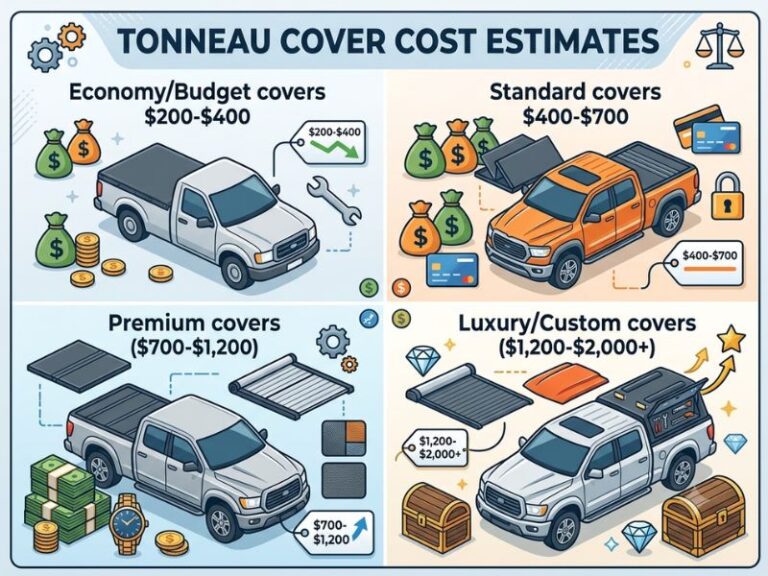
How Much Does a Tonneau Cover Cost Compared With Potential Fuel Savings?
A tonneau cover can pay for itself through fuel savings only if the improvement is consistent, the truck travels enough highway miles, and the cover’s purchase and installation cost are reasonable. For many owners, the financial payback is slow or uncertain.
To estimate payback, multiply the expected fuel savings by annual fuel use and the price paid per gallon. Then compare that amount with the cover, installation, replacement parts, maintenance, and any cost associated with reduced cargo flexibility.
For example, a small percentage improvement on a truck that is driven a few thousand miles per year may produce very little dollar savings. A truck used for long-distance highway commuting may accumulate more savings, but the result still depends on whether the measured improvement is real and repeatable.
Most buyers choose tonneau covers for several reasons at once:
- Keeping rain, snow, and road debris away from cargo.
- Improving cargo security by hiding items from view.
- Reducing wind exposure for light or unsecured belongings.
- Creating a cleaner appearance.
- Making occasional hauling more convenient.
Those benefits can justify the purchase even when fuel savings alone do not. A cover should be evaluated as a cargo-management accessory first and an aerodynamic accessory second.
Does a Tonneau Cover Affect Safety or Truck Operation?
A properly installed cover should not interfere with safe driving, visibility, lighting, or cargo restraint. The main risks arise when the cover is incompatible, unsecured, overloaded, or used with cargo that prevents proper closure.
Before driving, confirm that all clamps, latches, straps, rails, and support bows are secure. A loose cover can detach, obscure following traffic, damage the truck, or create a hazard for other drivers.
Follow the cover’s load limits and do not place people, animals, or unapproved heavy objects on top of it. A closed bed does not automatically mean cargo is safely restrained; heavy items can still move during braking or a collision.
Pay attention to the following warning signs:
- The cover flaps, balloons, or shifts at highway speed.
- A latch does not fully engage on one or both sides.
- The cover blocks the third brake light or rear lighting.
- A rack, toolbox, or bed liner prevents a proper fit.
- Water enters because seals are folded, pinched, or displaced.
- The cover makes contact with the cab, tailgate, or painted surfaces.
Some covers are not designed to be driven partially open. If the product permits open or folded operation, secure it exactly as directed. Otherwise, close or remove it before driving.
How to Maintain a Tonneau Cover for Consistent Performance
Maintenance will not guarantee fuel savings, but it helps preserve the cover’s shape, fit, and safety. A cover that loosens, sags, or develops damaged seals is less likely to provide consistent airflow or cargo protection.
Clean dust and grit from the cover and rails using the care method recommended for the material. Abrasive dirt can wear fabric, scratch painted surfaces, and interfere with latches or sliding components.
Inspect the system periodically, especially after hauling cargo or driving on rough roads. Look for:
- Loose clamps and mounting brackets.
- Cracked hinges or damaged panel joints.
- Stretched fabric, torn stitching, or broken support bows.
- Worn seals and missing end caps.
- Water pooling or new contact marks.
- Rails that have shifted out of alignment.
Keep the cover correctly tensioned if it uses adjustable tensioners. Do not overtighten fabric, because excessive tension can stress seams and hardware without improving the truck’s aerodynamics.
During freezing weather, avoid forcing a cover open when fabric, seals, or latches are frozen. Clear ice carefully and follow the product’s temperature and storage guidance. A damaged seal or bent rail can create more trouble than the small fuel effect the cover was purchased to provide.
Common Misconceptions About Pickup-Bed Aerodynamics
“Any cover guarantees better mileage.”
A cover changes airflow, but that does not guarantee a measurable improvement in fuel economy. Vehicle design, speed, weight, weather, and installation determine whether the net result is positive.
“A cover eliminates bed drag.”
It does not. The cover may reduce some turbulence around the bed, but the truck still creates drag at the cab, wheels, mirrors, underbody, tailgate, and rear wake.
“The biggest advertised percentage applies to every truck.”
Marketing claims may reflect specific test conditions, selected vehicles, or comparisons that do not match normal driving. Treat any percentage as a possibility to verify, not a guaranteed result.
“The most expensive cover must save the most fuel.”
Price often reflects materials, security, convenience, construction, warranty, and appearance. Those features may be valuable, but they do not automatically produce the best aerodynamic result.
“Fuel economy improvement means lower total operating cost immediately.”
A cover can require maintenance, replacement seals, repairs, or installation expenses. Calculate the full cost and consider its cargo and security benefits separately from the fuel question.
When Professional Installation Makes Sense
Many tonneau covers can be installed by a careful owner with basic tools, but professional help is useful when the truck has a bed liner, utility rails, a rack, a toolbox, unusual tailgate geometry, or integrated electronic equipment.
Professional installation may also be worthwhile when the cover must seal tightly, when alignment is difficult, or when the product is heavy and awkward to position. A shop can identify interference that might otherwise damage paint, seals, clamps, or bed rails.
Ask for help if the cover remains loose after adjustment, cannot latch evenly, contacts the cab, blocks lighting, or creates persistent wind noise. Those problems are not merely cosmetic; they can affect security and safe operation.
FAQ About Tonneau Covers and Fuel Economy
Does a tonneau cover improve fuel economy on every pickup?
No, a tonneau cover does not improve fuel economy on every pickup. Its effect depends on speed, bed design, cover fit, payload, weather, and driving conditions, and the change may be too small to measure in normal use.
Does a tonneau cover improve fuel economy more on the highway?
Yes, highway driving gives a cover the best opportunity to help. Aerodynamic drag becomes more important as speed rises, while city driving is dominated more by braking, acceleration, idling, and traffic.
Is a hard tonneau cover better for fuel economy than a soft one?
Not necessarily; a well-fitted cover is more important than the material. A hard cover may hold a flatter shape, but a properly tensioned soft cover can also reduce airflow disruption without adding as much weight.
Will removing the tailgate improve fuel economy more than adding a cover?
Removing the tailgate is not a reliable fuel-economy strategy. Tailgate airflow is complex, and removal can create cargo, equipment, and safety problems while producing no predictable benefit.
Can a tonneau cover improve towing fuel economy?
It may have a small effect, but it is unlikely to transform towing mileage. The trailer, towing speed, wind, load, and terrain usually create much larger influences on total fuel consumption than the pickup bed alone.
How can I tell whether my tonneau cover saves fuel?
Compare several tanks before and after installation under similar conditions. Use hand-calculated miles per gallon, keep tire pressure and payload consistent, and account for weather, route changes, towing, and strong winds.
Can a tonneau cover reduce fuel economy because it adds weight?
Yes, added weight can offset some or all of the aerodynamic benefit. The net result depends on how much weight the complete cover system adds and whether the truck is driven mostly at highway speed or in stop-and-go traffic.
Is a tonneau cover worth buying only to save gas?
Usually, fuel savings alone are not a strong reason to buy one. The potential improvement is modest and uncertain, so the purchase makes more sense when cargo protection, security, weather resistance, and convenience are also important.
Conclusion: Treat Fuel Savings as a Possible Bonus
A tonneau cover can improve fuel economy modestly by smoothing airflow over an open pickup bed, especially during steady highway driving. The result is not guaranteed, and a cover cannot overcome major influences such as heavy payloads, towing, low tire pressure, aggressive driving, strong headwinds, or frequent short trips.
Choose a cover that fits the exact truck, remains flat and secure, supports the way the bed is used, and does not add unnecessary bulk or weight. If fuel savings matter, test the truck over multiple comparable tanks rather than relying on a single trip or an advertised percentage. The cover’s dependable benefits are usually cargo protection and convenience; any reduction in fuel use should be treated as a potential bonus.