How to Reset Ford TPMS: A Clear, Practical Tire Pressure Guide
A TPMS warning light can be unsettling, especially when the tires look properly inflated and the vehicle drives normally. On a Ford, the light may need more than a button press: the system might need to relearn each wheel sensor, or the warning may be pointing to a low tire, a sensor problem, or a fault that a reset cannot fix.
The good news is that most owners can complete the basic process safely. First check and correct the tire pressures, then identify whether your Ford uses an automatic drive cycle, an instrument-cluster reset, or a manual sensor-training procedure. The exact method depends on the model, model year, trim, and whether the vehicle has direct or indirect TPMS.
This guide explains how to reset ford tpms without guessing at the sequence. You will learn how to prepare the vehicle, use the appropriate relearn method, recognize successful sensor programming, and decide when the warning indicates a problem that needs a tire shop or qualified technician.
At a glance
- Set all tires to the pressure on the driver-door placard, not the number molded into the tire.
- Ford TPMS relearn methods vary; the owner’s manual is the final authority for your specific vehicle.
- A warning that returns after correct pressure and relearning usually needs diagnosis, not repeated resets.
How to reset ford tpms safely and confirm the result
Ford vehicles do not all use the same reset process. Some relearn sensor locations while you drive, some provide a reset option in the information display, and others require a TPMS training tool that activates each sensor in a prescribed order.
Before starting, park on a level surface away from traffic. Do not use a reset procedure to hide a tire that is losing air, visibly damaged, or unsafe to drive. If a tire is cut, bulging, badly worn, or rapidly losing pressure, stop and have it inspected before continuing.
Tools you will need
- A reliable tire-pressure gauge for checking every tire, including the spare when applicable
- An air compressor or suitable inflation source to adjust pressure
- Your Ford owner’s manual, which identifies the correct pressure and relearn method
- Optional: a Ford-compatible TPMS activation or training tool if your model requires manual sensor activation

Step 1 Find the specified cold tire pressures
Open the driver’s door and look for the tire-information placard on the door jamb or the edge of the door. It lists the recommended cold pressure for the front and rear tires and may list a separate pressure for a temporary or full-size spare.
“Cold” means the vehicle has been parked long enough for the tires to cool, away from direct heat when possible. Driving warms the air inside the tires and raises the reading, so do not reduce pressure based only on a measurement taken immediately after a trip.
Do not use the maximum pressure printed on the tire sidewall as the Ford setting. That number describes the tire’s limit under specified conditions; the vehicle placard is the setting Ford uses for handling, load, and ride balance.
Step 2 Inspect and measure every tire
Remove the valve cap and press the gauge firmly onto each valve stem. Record the readings before adjusting them so you can notice a tire that is significantly lower than the others. Look across the tread and sidewalls for nails, screws, cracks, bulges, or uneven wear.
Inflate or release air until each tire matches its placard value. Replace the valve caps afterward. If one tire is much lower, becomes low again, or makes a hissing sound, do not proceed as if a reset solved the problem; the tire needs repair or replacement according to its condition.
Check the spare when your Ford’s TPMS monitors it. Some vehicles monitor a full-size spare, while others do not monitor a temporary spare until it is installed. Your manual and placard explain which arrangement applies.
Step 3 Identify your Ford’s relearn method
Use the index or tire-pressure section of the owner’s manual to look for terms such as TPMS reset, sensor training, relearn, or tire pressure monitoring system. If you do not have the manual, inspect the instrument-cluster menus for a tire-pressure reset option, but do not assume that every Ford with a TPMS light has a user-accessible reset command.
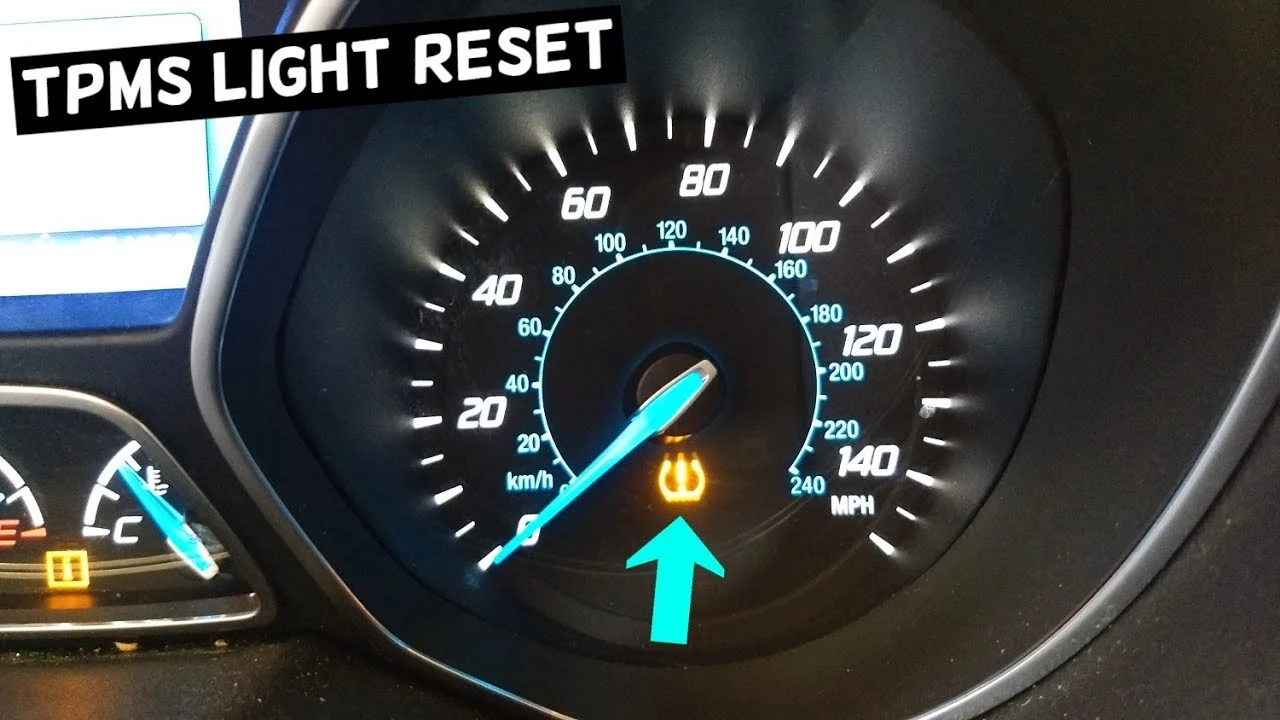
The warning light itself also provides a clue. A steady tire-shaped light commonly indicates low pressure. If the light flashes for roughly a period after the vehicle is started and then remains illuminated, Ford commonly treats that pattern as a TPMS fault, such as a missing or malfunctioning sensor.
Exact behavior can vary, so confirm it in the manual.
Most Ford procedures fit one of these categories:
- Automatic relearn: after pressure is corrected, the vehicle recognizes the sensors during normal driving.
- Menu-based reset: an information-display command stores the current pressure reference or starts a relearn process.
- Manual sensor training: the vehicle is placed in a training mode, and a compatible tool activates each sensor in order.
How to reset ford tpms correctly depends on choosing this method before you begin. A menu reset will not replace a required sensor-training sequence, and driving alone will not program a sensor if the vehicle specifically requires an activation tool.
Step 4 Prepare the vehicle for relearning
Close all doors, switch off accessories, and make sure the vehicle is safely parked. Keep the ignition key or key fob inside the vehicle. If your Ford has a push-button start, follow the manual’s instructions for entering accessory or ignition-on mode without starting the engine.
For a menu-based process, turn the ignition on and open the vehicle-information display. Look for a vehicle settings, driver assistance, tire, or TPMS menu. Select only the tire-pressure or sensor-relearn command described for your model.
Do not select unrelated calibration options or disconnect the battery as a shortcut. Battery disconnection generally does not train tire sensors and can create other settings that require restoration.
Step 5 Complete the applicable Ford relearn procedure
If your manual specifies an automatic drive cycle, drive normally on roads where it is safe to maintain ordinary traffic speed. The vehicle may need time and several miles of driving to receive sensor information. Avoid expecting an immediate change when you leave the driveway.
If the display offers a reset command, select it and follow the prompts exactly. Some systems ask you to confirm the tire pressures, while others begin sensor learning. A message such as “training complete,” “tire pressure reset,” or a similar confirmation indicates that the command was accepted, but it does not prove that every tire is correctly inflated.
If your Ford requires manual sensor training, enter the training mode using the sequence in the owner’s manual. Many Ford systems use the vehicle horn or a display message to indicate that training mode is active. Then activate the sensor at each wheel in the specified order, commonly beginning at the left front and continuing around the vehicle, but never rely on that order without checking your manual.
Hold the compatible TPMS tool against the tire sidewall near the valve stem when activating each sensor. A horn chirp, display message, or other vehicle response usually confirms that the vehicle received that sensor’s signal. If no response occurs, reposition the tool near the valve stem and retry once; repeated failure can indicate a dead sensor battery, incorrect tool, or incompatible sensor.
A useful way to approach how to reset ford tpms is to check your progress after each stage.
Important
Keep hands, clothing, and the activation tool clear of moving traffic and never train sensors while a person is working near a wheel that could move. If the procedure requires lifting the vehicle or removing a tire, stop and use proper lifting equipment or have a qualified tire professional do it.
Step 6 Finish the sequence and exit training mode
Continue until every monitored wheel has been accepted. If the vehicle expects a spare-tire sensor, include it; if it does not, activating an extra wheel may prevent the sequence from completing. The manual will state whether the spare is part of the order.
After the final sensor, look for a completion message or listen for the confirmation signal. Turn the ignition off, then restart the vehicle. Some Fords clear the training state automatically; others require you to leave the menu or drive away.
Do not replace a sensor, rotate the wheels, or change the sensor order halfway through the procedure unless the manual tells you to. A sensor can be healthy yet assigned to the wrong wheel if the training sequence is interrupted or performed out of order.
Step 7 Drive and confirm the warning has cleared
Take a normal test drive only after all tires are properly inflated and the vehicle is safe to operate. Watch the instrument cluster during startup and while driving. The TPMS light should turn off, and any tire-pressure display should show believable readings rather than a blank, missing, or obviously incorrect value.
After parking, recheck the pressures when the tires are cold. The final check matters because a successful relearn confirms communication or stores a reference; it does not correct a leak or inflate a tire.
Check your result
A successful result is a normal startup with no continuing TPMS warning, stable tire pressures, and no tire that drops noticeably below the door-placard setting after the test drive.
Why Ford TPMS resets sometimes behave differently
TPMS is the tire pressure monitoring system. In a direct system, each wheel normally contains a pressure sensor that sends pressure information and an identification code to the vehicle. In an indirect system, the vehicle estimates a change in tire size or rotation speed through the anti-lock brake sensors rather than measuring pressure at each valve.
That distinction explains why one Ford may require sensor programming while another mainly needs properly set pressures and a stored baseline. A replacement wheel, new sensor, tire rotation, or winter-wheel set can also change what the vehicle needs to learn.

Reset versus relearn
A reset usually tells the vehicle to accept a pressure reference or clears a stored warning. A relearn teaches the vehicle which sensor belongs at each wheel. These are related but not identical operations.
For example, if a wheel was replaced with a compatible sensor, the vehicle may need sensor identification before it can display pressure. If the same wheels remain on the vehicle and only the pressures changed, a drive cycle or menu reset may be enough, depending on the Ford system.
Why the spare tire can matter
A full-size spare may contain a sensor, but not every Ford monitors it in the same way. Some vehicles include the spare in the relearn order; others only recognize it after installation. A temporary spare may not provide normal TPMS information at all.
Do not assume that the four tires visible on the vehicle are the complete sensor set. Check the manual before beginning a manual sequence, especially after a flat-tire repair or wheel change.
What to do when the TPMS light stays on
A light that remains on after the tires are set and the correct procedure is completed usually has a reason. The most useful clue is whether the light is steady or flashes first, but the vehicle’s message center may provide more specific information.
| What you observe | Likely direction | Next action |
|---|---|---|
| Light turns on steadily while driving | One or more tires may be below the specified pressure | Check all tires cold and inspect for a leak |
| Light flashes, then stays on | System fault, missing sensor, or communication problem | Have the TPMS scanned or inspected |
| Pressure display shows a dash or missing wheel | Sensor is not being received or is not programmed | Repeat the correct relearn once, then seek diagnosis |
| Light returns after a day or two | Slow leak, damaged valve, or sensor issue | Measure cold pressure again and arrange a tire inspection |
When relearning does not work
First verify that you used the procedure for the exact model and year, not a similar Ford. Confirm that the replacement sensors are compatible with the vehicle and that a manual activation tool supports the sensor type.
Cold weather can lower tire pressure enough to trigger the warning, while a puncture can cause a gradual loss that is difficult to notice visually. Also consider a sensor with a depleted internal battery; many TPMS sensors are sealed units, so the sensor is replaced rather than recharged.
If the warning started immediately after new tires or wheels were installed, return to the installer and ask whether the sensors were transferred, damaged, replaced, or left unprogrammed. A tire shop can often identify sensor signals and determine whether each sensor is transmitting.
When to stop driving
Do not continue driving normally if a tire is visibly damaged, rapidly losing air, severely underinflated, or hot and abnormal compared with the other tires. Use the vehicle’s spare and follow its instructions if appropriate, or arrange roadside assistance.
Seek professional help when the light flashes, a sensor cannot be activated, the vehicle reports a TPMS fault, or the warning returns despite verified pressures. The system may need a scan tool, sensor replacement, valve service, or a wiring diagnosis that a simple reset cannot provide.
Frequently asked questions about Ford TPMS
These answers cover common beginner concerns, but the model-specific owner’s manual still controls the exact sequence and pressure requirements.
Can I reset Ford TPMS by disconnecting the battery?
No. Disconnecting the battery is not a dependable way to relearn tire sensors and may erase unrelated vehicle settings. Use the prescribed menu, drive cycle, or sensor-training process instead.
How long does it take for the Ford TPMS light to turn off?
It may turn off after the vehicle recognizes corrected pressure, or it may require a drive cycle after a relearn. The timing varies by model. If it remains on after the specified procedure and a normal test drive, investigate the tires and sensor system rather than repeatedly resetting it.
Do I need a TPMS tool for every Ford?
No. Some Ford models relearn automatically or provide a menu-based process. A compatible activation tool is needed only when the model’s manual sensor-training procedure calls for one.
Will rotating my tires cause the TPMS light to come on?
Rotation alone may not create a warning, but some systems need the sensor positions relearned so the displayed wheel locations remain accurate. Follow the rotation and relearn instructions for your vehicle.
Why is the light on when all four tires look full?
A tire can be below specification without looking flat, and a slow leak may not be visible. Measure each tire with a gauge. If the pressures are correct, a flashing light, missing pressure reading, or recent wheel work points toward a sensor or system fault.
Confirm the repair, not just the reset
Learning how to reset ford tpms starts with the tires, not the warning light. Set every monitored tire to the driver-door placard pressure, identify the correct Ford relearn method, complete the sequence carefully, and verify the result with the warning light, pressure display, and a second cold-pressure check.
If the warning returns, treat that as useful information. A slow leak, incompatible or unprogrammed sensor, dead sensor battery, or system fault may remain. Stop for unsafe tire conditions and use a qualified tire professional when the vehicle cannot recognize a sensor or the warning continues after correct pressure and relearning.