How Long Can You Drive on a Patched Tire: Key Facts and Guidance
A properly repaired tire can often remain in service for the rest of its tread life, but only when the puncture is repairable and the repair uses an approved internal patch-plug.
A tire that looks fine from the outside may still have hidden internal damage. The visible plug or patch is only one part of the story; the puncture’s size, location, angle, and effect on the tire’s internal structure determine whether continued driving is reasonable.
People often ask how long can you drive on a patched tire because patched can describe several very different repairs A temporary rope plug installed from the outside.
You will learn how repair standards apply to tread punctures, why driving distance is less important than repair quality and tire condition, how to check a repaired tire before a trip, and how to decide whether a shop should repair, replace, or refuse the tire.
- ✓A professional patch-plug repair in the central tread can last for the remaining usable life of a healthy tire.
- ✓An outside-only rope plug is generally a temporary measure, not the preferred permanent repair.
- ✓Sidewall, shoulder, large, angled, or run-flat damage may require tire replacement rather than repair.
- ✓Low pressure, vibration, bulging, air loss, or heat are reasons to stop driving and have the tire inspected.
How Long Can You Drive on a Patched Tire?
The realistic answer depends less on a number of miles and more on whether the tire was correctly evaluated and repaired A permanent repair can remain safe for.
That does not mean every tire with a patch is suitable for unlimited driving A repair cannot reverse internal separation damage caused by driving while flat excessive heat.
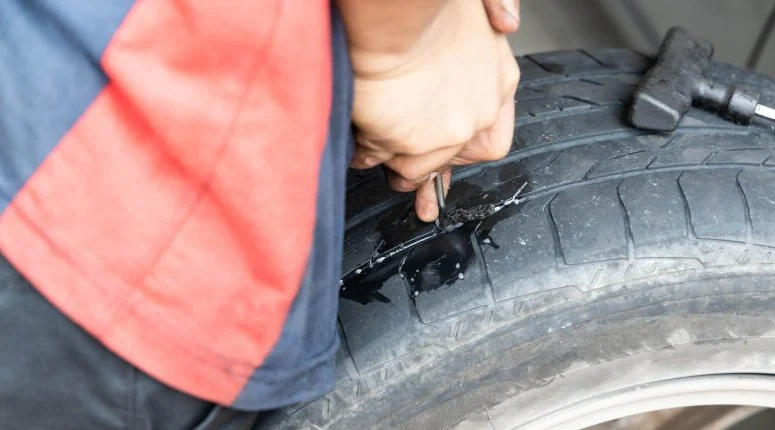
- Repair quality matters: A combination patch-plug installed from inside the tire seals the puncture channel and covers the inner liner.
- Location sets the limit: The center tread is the usual repair zone; the shoulder and sidewall flex too much for a dependable repair.
- Condition comes first: A repaired tire with adequate tread can still be unsafe if it has been driven underinflated or shows structural damage.
For example a small nail straight through the middle grooves of a relatively new tire is a very different case from a screw near the shoulder that caused.
What Makes a Tire Repair Permanent?
People sometimes use “patch” to describe any material placed in a puncture. In tire service, however, the method matters. A proper permanent repair normally requires removing the tire, inspecting the inside, preparing the puncture channel, and installing a combination unit that seals both the hole and the inner liner.
An external string plug can stop air from escaping and may be useful as an emergency roadside measure It does not allow a technician to inspect the inner.

- Internal inspection: The tire should be removed from the wheel so the inside can be examined for abrasion, exposed cords, or heat damage.
- Combination repair: A patch-plug, sometimes called a stem-and-patch repair, seals the puncture path and reinforces the inner liner.
- Correct preparation: The repair area must be cleaned and prepared according to the repair material’s instructions.
- Leak testing: The repaired tire should be inflated to the vehicle’s specified pressure and checked for leaks before returning to service.
Patch, plug, and patch-plug compared
| Repair type | What it does | Typical role | Main limitation |
|---|---|---|---|
| External rope plug | Fills the puncture channel from outside | Temporary emergency repair | Does not permit internal inspection or fully seal the inner liner |
| Internal patch | Covers the hole on the inside surface | May be appropriate in some applications | By itself, it may not seal the puncture channel properly |
| Patch-plug | Seals the channel and covers the inner liner | Preferred permanent repair for suitable tread punctures | Cannot make sidewall or structurally damaged tires safe |
Some tire shops may use different approved repair materials or procedures so the name of the product is not the only issue The important questions are whether the.
Which Punctures Can Be Repaired?
Most repairable punctures share several characteristics: they are relatively small, caused by a straightforward object such as a nail or screw, and located in the central tread. The tire must also have sufficient tread, no significant weather cracking, and no evidence that it was driven while seriously underinflated.
The exact size limits can vary by tire maker and repair guidance, so a technician should measure the damage rather than estimate it by eye. A puncture that looks tiny on the outside may be enlarged inside, especially if the object entered at an angle or was pulled out before inspection.

- Puncture location: Damage in the main tread area is more likely to qualify than damage in the shoulder or sidewall.
- Puncture path: A straight, limited channel is easier to repair than a cut, tear, or irregular hole.
- Tire history: Previous repairs, repeated air loss, or a recent low-pressure drive can change the decision.
- Remaining life: A tire near its wear indicators may not justify repair, even if the puncture itself is repairable.
Why the shoulder and sidewall are different
The sidewall bends and flexes substantially as the tire rolls. The shoulder, where the tread transitions into the sidewall, also experiences changing forces that make a repair less stable. Repair material that seals a rigid tread puncture may not tolerate the repeated flexing in these areas.
A sidewall puncture, cut, bulge, or exposed cord is therefore generally a replacement issue. The sidewall carries important structural components, and an external patch cannot restore damaged cords or guarantee that the casing will withstand normal load and speed.
When a small puncture is still unsafe
Size alone does not make a repair acceptable A tire that has been driven several miles with little or no air may develop internal chafing and heat damage.
Multiple repairs close together can also weaken the tread area or leave too little material between repair zones A technician may decline a repair when the puncture overlaps.
Why Distance Is Not the Only Measure
Searching for a mileage limit is understandable, but a single number cannot account for the conditions a tire faces. A properly repaired tire on a correctly loaded vehicle may operate normally for years, while a poorly repaired tire can lose pressure on the next highway trip.
Speed, temperature, load, inflation pressure, road hazards, and the vehicle’s handling all influence the stress placed on the repaired area. Underinflation is especially important because it increases sidewall flex and heat. Heat can weaken rubber and accelerate damage that began with a minor puncture.
- Highway speed: Sustained speed creates more heat than slow local driving, especially when pressure is low.
- Heavy loads: Passengers, cargo, towing, and an overloaded vehicle increase tire deflection and operating temperature.
- Hot weather: Ambient heat and hot pavement add to the tire’s thermal stress.
- Rough roads: Potholes and debris can damage a repaired tire or wheel even when the original repair was sound.
This is why the answer to how long can you drive on a patched tire should be framed as a condition-based decision A good repair is not a countdown that expires after.
Pressure is a critical variable
Check pressure when the tires are cold, using the pressure listed on the driver’s door-jamb label or in the vehicle owner’s manual. That figure is the vehicle manufacturer’s operating recommendation; it is not necessarily the maximum pressure molded into the tire sidewall.
Monitor the repaired tire more closely for the first several drives A slow leak may not be obvious by looking at the tire and a tire-pressure monitoring system.
Temporary Plug Versus Professional Repair
An external plug has a legitimate but limited purpose. It can help restore mobility after a puncture when no immediate tire shop is available, allowing a driver to move to a safe location or service facility. The fact that it works in an emergency does not make it equivalent to a permanent repair.
This distinction matters when answering “how long can you drive on a patched tire”.
Driving on a temporary plug for an extended period creates uncertainty about the inner liner and casing. The plug may leak, work loose, or fail to seal the puncture channel completely. Moisture and contamination can also enter the tire, contributing to corrosion of internal components in some tire constructions.
- Confusing no leak with a permanent repair: A plug that holds air today has not proved that the tire is internally undamaged.
- Ignoring the object’s angle: A screw that entered diagonally may create a longer or irregular channel than it appears to have.
- Skipping pressure checks: A repaired tire still needs the same pressure monitoring as any other tire, and often deserves closer observation.
- Using a sealant as a substitute: Liquid sealants may complicate inspection and do not repair structural damage.
If a rope plug is already installed, ask a qualified tire professional to inspect the tire as soon as practical. The shop may be able to remove the temporary repair and install an approved permanent repair, but it may also find that the puncture or internal damage makes replacement safer.
Signs a Patched Tire Should Not Be Driven
A repaired tire should not be judged only by whether it looks round and inflated. Changes in handling, pressure, noise, or temperature can signal a problem that needs immediate attention. When a warning sign appears, reduce risk by avoiding high speeds, abrupt maneuvers, and unnecessary distance until the tire is inspected.
If the tire is visibly flat, severely low, bulging, cut, or shedding rubber, stop in a safe location rather than driving to a shop on it. Continuing to roll on a damaged tire can turn a repairable puncture into a destroyed casing and may damage the wheel.
- Repeated pressure loss: Needing to add air more than once suggests a leak, valve problem, wheel issue, or failed repair.
- New vibration: A vibration through the steering wheel or seat may indicate imbalance, casing damage, or a wheel problem.
- Pulling or unstable handling: Changes in direction control can accompany pressure loss or structural failure.
- Bulge or deformation: A bubble in the sidewall is a serious structural warning and is not fixed by adding air.
- Heat or odor: An unusually hot tire or burning-rubber smell may indicate underinflation or internal friction.
What to do after a pressure warning
- Slow down smoothly and avoid hard braking or sharp steering.
- Move to a safe location away from traffic if possible.
- Inspect the tire without touching it immediately; a hot tire can cause burns.
- Use a pressure gauge when the tire has cooled enough for a meaningful reading.
- Install the spare or call roadside assistance if the tire is flat, damaged, or losing air.
- Have the tire and wheel inspected rather than assuming inflation solved the issue.
Do not remove a nail or screw at the roadside unless a tire professional has instructed you to do so. The object may be limiting air loss, and removing it can turn a slow leak into a rapid deflation before you are in a safe place.
How to Check a Repaired Tire Before a Road Trip
A road-trip check cannot replace a professional internal inspection, but it can identify obvious problems before you commit to long-distance driving. Begin with the tire cold and compare its pressure with the vehicle’s recommended setting. Check all four tires, because a handling problem may not come from the repaired tire alone.
Look across the tread and sidewall for cuts, bulges, exposed cords, embedded objects, uneven wear, or a repair that appears to be pulling out. Examine the valve stem and wheel rim as well; a leak near the bead or valve can be mistaken for a failed puncture repair.
- Measure cold pressure: Record the reading and correct it to the door-jamb specification.
- Inspect the tread: Look for new damage, separated rubber, unusual wear, or an object near the repair.
- Check the spare: Make sure it is present, inflated as specified, and accompanied by the required tools.
- Review the repair: If you do not know whether it was an internal patch-plug or an outside plug, ask the shop that performed it.
After the first part of the trip
During a long drive, stop periodically in a safe area and look for visible changes. Compare the repaired tire’s apparent condition with the other tires, but do not rely on a hand-touch temperature test as a precise diagnosis. If one tire looks significantly different or the vehicle begins vibrating, investigate before continuing.
Recheck pressure only when the tires are cool enough for the reading to be useful. Pressure naturally rises as tires heat up, so do not release air from a warm tire simply to make the gauge match the cold specification.
Factors That Determine Whether Replacement Is Better
Repair is not always the most economical or safest option. A tire may technically have a repairable puncture but be close to the end of its service life, have uneven wear, or be mismatched with the other tires. In those cases, replacement may provide better reliability and more predictable handling.
Consider the tire as a complete component rather than focusing only on the hole. Tread depth, age, maintenance history, previous repairs, load rating, speed rating, and compatibility with the vehicle all matter when deciding whether to keep it.
- Structural damage: Sidewall cuts, bulges, exposed cords, separation, or evidence of severe run-flat driving generally rule out repair.
- Excessive wear: A tire at or near its wear indicators may not be worth repairing.
- Multiple repairs: Closely spaced punctures or overlapping repair areas can reduce confidence in the tread.
- Age and deterioration: Cracking, hardening, or environmental damage can make the casing unsuitable even with a small puncture.
- Vehicle matching: All-wheel-drive vehicles may have specific requirements for tire circumference and tread-depth differences.
Ask the technician to explain why the tire is being refused if the answer is not obvious. A reputable evaluation should distinguish between a repair that is prohibited because of location, one rejected because of internal damage, and one that is simply not cost-effective.
How to Make a Repaired Tire Last Safely
A permanent repair does not eliminate normal tire maintenance. Maintaining the correct pressure reduces flexing and heat, while regular rotation and alignment checks help prevent uneven loading across the tread. Good maintenance also makes it easier to notice a change before it becomes a failure.
Use the vehicle’s recommended cold pressure and check it at least monthly and before extended trips. Inspect the tires after striking a pothole or curb, even if there is no immediate leak. Impact damage can affect the inner structure without leaving a dramatic mark on the outside.
- Keep pressure consistent: Correct underinflation promptly and investigate repeated loss rather than treating it as normal.
- Rotate as recommended: Even wear gives the repaired tire a more predictable operating life.
- Maintain alignment: Pulling, crooked steering, or rapid edge wear can overload part of the tread.
- Respect load limits: Do not exceed the vehicle, tire, or wheel load ratings, especially when towing or carrying a full cargo load.
- Drive for conditions: Avoid unnecessary speed and aggressive maneuvers when a tire has recently been repaired or inspected.
Do not apply a tire dressing or coating that makes it difficult to see cracks, bulges, or a repair area. Visual access matters, particularly on tires exposed to sun, stored outdoors, or used infrequently.
Frequently Asked Questions
Can a properly patched tire last the life of the tire?
Yes, a professionally inspected tire with a suitable tread puncture and an approved permanent repair can remain in service until normal wear, age, or another defect requires replacement. There is no universal mileage expiration for a sound repair.
How far can you drive on a tire with an outside plug?
Use an outside plug only to reach a safe place or tire service facility, unless a qualified professional has specifically approved the repair for continued use. An external plug does not confirm that the inner liner and casing are undamaged.
Can a tire be patched more than once?
Sometimes, but the answer depends on the spacing, location, size, and condition of the existing repairs. Repairs that overlap, are too close together, or involve a tire with other damage may require replacement.
Can a patched tire be used on the highway?
A properly completed permanent repair in a suitable tread location can generally be used for normal highway driving when the tire is correctly inflated and otherwise healthy. A temporary plug, low pressure, vibration, or visible damage changes that decision.
Is a tire patch safe near the shoulder?
Repairs near the shoulder are often rejected because that area flexes heavily and transitions into the sidewall. The exact boundary can be difficult to judge from outside, so the tire should be evaluated by a qualified technician rather than repaired based on appearance.
Can you drive on a patched tire if it is slowly losing air?
No. Continued air loss means the repair, valve, wheel, or tire may still have a problem. Repeatedly adding air can mask a developing failure and allows heat to build when the tire is driven underinflated.
Should a patched tire be replaced with the matching tire?
Replacement depends on tread depth, drivetrain requirements, tire condition, and the recommendations for the vehicle. All-wheel-drive systems may be especially sensitive to differences in tire circumference, so consult the owner’s manual or a qualified tire professional before replacing only one tire.
Conclusion
How long can you drive on a patched tire depends on the repair method puncture location internal condition inflation pressure and remaining tire life not on a fixed.
When in doubt, prioritize an internal inspection over a visual guess. The cost of evaluating or replacing a tire is far lower than the consequences of a failure at speed.
Before your next long drive, check the repaired tire cold, verify its repair type and pressure, and have it professionally inspected if it leaks, vibrates, or was repaired only from the outside.