Can You Patch a Tire with Two Holes: Clear Answers and Key Facts
You may be able to patch a tire with two holes if both are small, safely repairable punctures in the tread. A tire should be replaced when either hole is too close to another repair, the sidewall, or the shoulder.
Knowing whether can you patch a tire with two holes is more complicated than counting punctures. The location, size, spacing, angle, and condition of the tire determine whether a repair can restore dependable air retention—or merely postpone a more serious failure.
A rushed decision can overlook damage inside the casing an underinflated tire driven too far or two punctures positioned so closely that the tire s structure is weakened.
This guide explains how tire professionals evaluate multiple punctures why a combination patch-and-plug repair is generally preferred and when replacement is the safer choice You will learn what.
- ✓Two small punctures may be repairable when they are in the central tread, properly spaced, and the tire has no additional damage.
- ✓A professional should remove the tire from the wheel and inspect the inside before approving a permanent repair.
- ✓Sidewall, shoulder, overlapping, large, or irregular punctures usually require tire replacement rather than patching.
- ✓A combination plug-patch repair applied from inside is more reliable than an exterior string plug used by itself.
Can You Patch a Tire with Two Holes
Sometimes but only if both holes meet the same basic repair conditions A qualified tire technician must confirm that the punctures are in the repairable portion of the.
Repairability is not determined solely by whether the tire is holding air A puncture can damage cords allow moisture into the steel belt package or create a weak.

- Puncture location: The damage should be in the central tread area, not the sidewall or shoulder transition.
- Hole size: Small, clean punctures are more likely to qualify than cuts, tears, or enlarged holes.
- Spacing: Repairs must not overlap or leave an inadequately supported section between them.
- Internal condition: The casing must be free of inner-liner damage, exposed cords, and signs of driving while severely underinflated.
Even when two holes appear identical they may not have the same cause One could be a nail puncture while the other is a sharp cut from road debris.
Why location matters more than the number of holes
The tread is designed to contact the road and resist punctures, while the sidewall must flex repeatedly to absorb impacts and support the vehicle. A repair in the sidewall or shoulder can interfere with that flexing and is generally not considered a safe permanent repair.
The shoulder is the rounded area where the tread begins to turn toward the sidewall A puncture that looks like it is in the tread from above may.
Why two nearby holes are a special concern
Two punctures close together can remove too much rubber from one small area. If the damaged areas overlap, the technician may be unable to create two properly sealed repairs without weakening the surrounding material. The tire may also have hidden belt separation between the holes.
There is no universal spacing rule that applies to every tire, repair material, and manufacturer. A repair facility should follow the tire maker’s guidance and accepted industry practice rather than promise that any specific distance is safe for every model.
Which Tire Damage Can Usually Be Repaired?
Most repairable punctures are small penetrations made by nails, screws, or similar objects that enter relatively straight through the central tread. The object may leave a neat channel that can be cleaned, filled, and sealed with a suitable internal repair.
The tire must also be structurally sound. A repairable tread puncture on a newer tire can be a reasonable candidate, while the same puncture on a tire with severe wear, cracking, previous abuse, or an uncertain driving history may justify replacement instead.
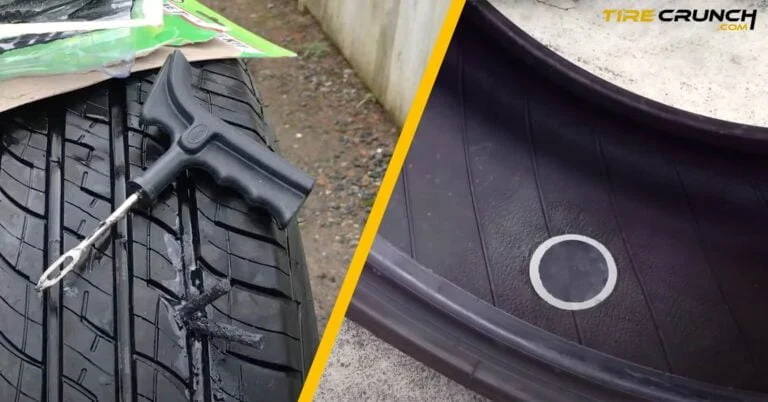
- Central tread: The puncture is well away from the sidewall and shoulder area.
- Limited damage: It is a small, clean hole rather than a slit, tear, or wide irregular opening.
- Sound casing: No bulge, exposed cords, belt separation, or inner-liner abrasion is present.
- Serviceable tire: Tread, age, and overall condition still support continued use.
Small punctures from nails and screws
A straight nail or screw puncture is often easier to assess because the object’s path is clear. The technician can mark the entry point, remove the tire, inspect the inside, and determine whether the channel can be properly prepared for a repair.
Do not remove an embedded object before the tire is inspected if the tire is still holding air Pulling it out may cause a rapid leak and make.
When a puncture becomes a cut or tear
Road debris can produce a jagged cut rather than a simple hole. Cuts may separate cords, stretch the inner liner, or continue growing as the tire flexes. A repair material may seal the surface while leaving the underlying structure compromised.
Likewise, a puncture made while the tire is rolling at low pressure can become elongated. The entry hole may look small after the object is removed, but the internal channel can be distorted. That history matters even when the visible damage seems modest.
Previous repairs and crowded tread areas
A tire with one existing repair is not automatically unsafe, but a second puncture changes the evaluation. Repairs that are too close, crossing, or clustered in one section can weaken the tread and make it difficult to install a proper internal repair.
A technician should identify every previous repair, not just the two newest holes. Exterior plugs, patches of unknown quality, and repairs that were installed without removing the tire all affect the decision. If the history cannot be verified, replacement may provide a more predictable outcome.
This distinction matters when answering “can you patch a tire with two holes”.
When Two Holes Mean the Tire Should Be Replaced
Replacement is usually the correct choice when either puncture lies outside the central tread repair zone or when the casing has suffered structural damage The fact that a.
Replacement may also be appropriate when the tire has been driven significantly underinflated. A low tire can be pinched between the wheel and road, generating heat and scraping the inner liner. This damage may remain hidden until the tire fails later.

- Sidewall or shoulder damage: Do not treat these areas like ordinary tread punctures.
- Bulges or bubbles: These indicate possible internal separation or impact damage and require replacement.
- Exposed cords: Visible structural material is a replacement condition, not a patching opportunity.
- Severe air loss: Driving on a flat or nearly flat tire can damage the casing beyond repair.
Sidewall and shoulder punctures
The sidewall has no thick tread package to accept a conventional puncture repair. It also flexes much more than the tread, so a repair installed there can be subjected to movements it was not designed to tolerate.
Shoulder repairs are similarly problematic because they sit near the point where tread forces and sidewall flex meet. Even if a shop can physically insert repair material, responsible technicians commonly decline the job when the puncture is too close to the shoulder.
Overlapping holes or a damaged area between them
If two holes overlap, the tire no longer has two independent punctures. It has one larger damaged zone, and the surrounding rubber may not provide enough material for a dependable seal. A broad cut between two holes creates the same concern.
Two holes can also be unsafe when they are separated by a narrow strip of tread. That strip may look intact but have weakened cords underneath. A technician may recommend replacement because the risk cannot be eliminated by adding more repair material.
Age, wear, and mismatch concerns
A repair decision should consider the whole tire, not just the punctures. Tires with very little remaining tread, significant cracking, uneven wear, or other damage may not offer enough remaining service life to justify a repair.
On vehicles with all-wheel drive, replacing one tire can raise additional fit concerns if the replacement tire has a substantially different rolling circumference from the others. The vehicle owner’s manual or tire manufacturer guidance should be checked before replacing only one or two tires.
How a Professional Repairs Multiple Tread Punctures
A proper permanent repair normally requires removing the tire from the wheel. This gives the technician access to the inner liner, allows a full inspection, and makes it possible to prepare the puncture channel correctly.
The commonly preferred approach is a combination repair that seals the puncture channel and covers the inside of the tire The plug portion fills the path through the.
- Locate and assess: The technician identifies every puncture and checks its position, direction, and size.
- Inspect internally: The inner liner and cords are examined for damage caused by penetration or low pressure.
- Prepare the area: The puncture channel and inner liner are cleaned and prepared according to the repair system.
- Seal from inside: An approved combination repair is installed, then the tire is reassembled, inflated, and checked for leaks.
Why an exterior plug is not the same as a permanent repair
A string plug inserted from outside can be useful as a temporary roadside measure when a tire is punctured It may stop air loss long enough to reach.
Exterior plugs can also be installed incorrectly, leaving leaks or allowing moisture to reach the belt area. They should not be treated as proof that a tire is safe for continued service, especially when there are two punctures.
What the technician should verify afterward
After repair, the tire should be inflated to the vehicle’s specified pressure and checked for leaks. The valve stem, bead area, and both repair sites deserve attention because air loss may come from a different location than the obvious puncture.
The wheel should also be rebalanced if needed, particularly if the tire was removed from the wheel. The technician may recommend monitoring pressure more closely for the first several days. Any recurring pressure loss, vibration, bulge, or unusual noise should prompt another inspection.
How to Decide Between Repair and Replacement
The decision becomes clearer when you separate three questions: Is the puncture technically repairable? Is the rest of the tire structurally sound? Is repair the sensible value given the tire’s condition and the vehicle’s requirements?
Keep these limitations in mind when considering “can you patch a tire with two holes”.
For example, two small nails in the center tread of a healthy tire may be repair candidates. Two holes near the shoulder of a worn tire, especially after driving while flat, point strongly toward replacement. The visible number of holes is only one part of the assessment.
| Situation | Likely decision | Reason |
|---|---|---|
| Two small, separate holes in central tread | Professional repair may be possible | The damage may be limited and accessible to a combination repair. |
| One hole in the shoulder and one in the tread | Usually replace | The shoulder puncture is outside the normal repair zone. |
| Overlapping punctures or a long cut | Replace | The damaged area may lack enough sound material for a reliable seal. |
| Visible bulge, exposed cords, or belt separation | Replace immediately | These signs indicate structural damage beyond a simple puncture. |
| Repairable punctures in a severely worn tire | Replacement often makes more sense | A repair cannot restore tread life or correct broader deterioration. |
Questions to ask at the tire shop
You do not need to diagnose the tire yourself, but you should receive a clear explanation. Ask where each puncture is located, whether the tire was inspected from the inside, and whether any internal abrasion or cord damage was found.
- Ask whether both holes are within the manufacturer’s repairable tread area.
- Ask whether the punctures overlap or are too close to one another.
- Ask whether the tire shows evidence of being driven underinflated.
- Ask whether the proposed repair is an internal combination repair or only an exterior plug.
- Ask whether tread wear, age, cracking, or vehicle drivetrain requirements change the recommendation.
A trustworthy explanation should identify the actual limitation rather than rely on a simple “yes” or “no.” If a technician recommends replacement, the reason should relate to location, structural condition, wear, or repair spacing.
When a second opinion is reasonable
A second opinion can be useful when the punctures appear clearly different from the technician’s description or when the recommendation is not explained. Take the tire to another reputable tire service location rather than repeatedly driving on it while searching for an answer.
A second opinion should not be used to shop for the answer you prefer. If two qualified technicians identify sidewall damage, internal abrasion, or overlapping punctures, replacement is the prudent response.
What to Do Before You Reach a Repair Shop
Safety begins before the tire is inspected A tire with multiple holes can lose pressure quickly and driving on it may turn a repairable puncture into a ruined.
If the tire is visibly flat, the vehicle pulls, the steering feels unusual, or the tire has a bulge, do not continue driving on it. Use a spare if it is correctly inflated and suitable for the vehicle, or contact roadside assistance.
- Look for the cause: Leave an embedded nail or screw in place until a technician can assess it, when safe.
- Check pressure: Compare the reading with the vehicle placard, not the maximum pressure molded into the tire.
- Avoid sealant assumptions: Emergency sealants may complicate inspection and are not a substitute for a proper repair.
- Record the symptoms: Note when the pressure dropped, whether the tire was driven flat, and whether vibration occurred.
Do not rely on repeated inflation
Adding air may temporarily restore the tire’s shape, but it does not reverse internal damage. If a tire loses pressure again soon after inflation, treat that as evidence of an unresolved leak or structural problem.
Driving several miles at low pressure can generate enough heat to damage the inner liner. The longer and faster the tire is driven in that condition, the less likely it is to qualify for repair.
Use the vehicle’s pressure information correctly
The recommended cold inflation pressure is normally listed on the driver’s doorjamb placard or in the owner’s manual. It is the starting point for checking a tire, though a temporary spare may have a different requirement.
Do not judge safety by appearance alone. Radial tires can look reasonably shaped even when they are underinflated, and a tire can appear full while losing air through a puncture or valve problem.
Preventing Repeat Punctures and Uneven Wear
A repaired tire still needs normal maintenance. Maintaining the correct pressure helps the tread contact the road evenly and reduces excess flexing. It also makes it easier to notice a slow leak before the tire becomes severely underinflated.
Inspect the tread periodically for embedded objects, cuts, cracks, and unusual wear. A nail may not cause an immediate warning if the object temporarily seals the hole. A tire pressure monitoring system can alert you to pressure loss, but it does not replace physical inspection.
- Monitor pressure: Check tires when cold and before long trips or heavy loads.
- Rotate as specified: Regular rotation can help identify and limit uneven tread wear.
- Inspect alignment symptoms: Feathering, edge wear, or pulling may indicate alignment or suspension issues.
- Check repairs: Reinspect a repaired tire if pressure changes, vibration, or handling symptoms return.
Keep a record of repairs, including the tire position and approximate date. This helps a technician identify crowded repair areas and prevents a previous repair from being overlooked during a later inspection.
FAQ About Can You Patch a Tire with Two Holes
Can you patch a tire with two holes if both are in the tread?
Possibly. Both holes must be small, separated, located within the central repairable tread area, and free from internal casing damage. A technician must inspect the tire after removing it from the wheel.
How close can two tire punctures be before replacement is needed?
There is no single spacing number that safely applies to every tire and repair system. If the repairs overlap, leave only a narrow section between them, or compromise the same structural area, replacement is generally safer.
Can you patch a tire with two holes on opposite sides of the tread?
Two well-separated central-tread punctures may be repairable, but the exact positions still matter. If either hole reaches the shoulder, sits outside the accepted repair area, or is associated with internal damage, the tire should be replaced.
Is an outside plug enough for two punctures?
An outside plug may serve as a temporary measure to help you reach a repair facility, but it is not equivalent to a professional internal repair. The tire should be removed and inspected, particularly when more than one puncture is present.
Can a tire be repaired after being driven flat?
Sometimes a technician can approve it, but often driving flat damages the inner liner or cords. The tire must be inspected internally; if abrasion, heat damage, or deformation is present, replacement is required.
Should two punctures always mean buying a new tire?
No. Two punctures do not automatically make a tire unusable. A sound tire with two small, properly spaced central-tread punctures may qualify for a permanent repair, while location and condition matter more than the count alone.
Can you patch a tire with two holes near the sidewall?
Usually not. Punctures in the sidewall or shoulder are exposed to substantial flexing and are generally outside the safe repair area. Replacement is typically the appropriate solution.
Conclusion
Can you patch a tire with two holes? In some cases, yes—but only when both punctures are small, properly positioned, adequately separated, and surrounded by a structurally sound casing. A professional internal inspection is essential because air retention alone cannot reveal hidden damage.
Do not drive on a flat or visibly damaged tire and do not treat an exterior plug as a permanent answer When a puncture reaches the shoulder or.
Have the tire removed and internally inspected before approving any repair; if the damage is outside the central tread or the casing is compromised, replace it.