How to Fix Throttle Position Sensor: Test, Clean, Replace Safely
A throttle position sensor can make a healthy engine feel unpredictable. When it begins to fail, the vehicle may hesitate when you press the accelerator, surge at steady speed, idle poorly, or turn on the check engine light. Those symptoms can also come from a dirty throttle body, a damaged wire, a vacuum leak, or a problem with the accelerator pedal system, so replacing the sensor immediately is not always the best first move.
The practical answer to how to fix throttle position sensor trouble is to diagnose the signal before buying parts. On some vehicles, the sensor is a separate replaceable unit; on others, it is built into the throttle body and requires a complete throttle-body assembly. Cleaning the area and repairing a connector may solve the problem, while an accurate voltage test can confirm whether the sensor itself is failing.
This guide explains how to identify the sensor, inspect its wiring, test its output, clean the throttle body safely, replace the sensor when appropriate, and verify the result. It is written for a beginner with basic hand tools and, ideally, a digital multimeter or OBD-II scanner. Always use the service information for the exact year, engine, and model because connector layouts, voltage ranges, and relearn procedures vary.
At a glance
- Confirm the fault with wiring and signal checks before replacing a sensor.
- Do not force a sensor that is integrated into the throttle-body assembly.
- Clear the code only after the repair, then verify smooth throttle response and a stable idle.
How to Fix Throttle Position Sensor Problems
The safest method is a diagnosis-first process: identify the component, record any diagnostic trouble codes, inspect the circuit, measure the signal, and only then clean or replace parts. The engine should be off during physical inspection, and the vehicle should be parked on level ground with the parking brake set.
Tools you will need
- Basic socket and screwdriver set for removing covers or the sensor
- Digital multimeter for checking reference voltage, ground, and signal voltage
- OBD-II scanner for reading and clearing trouble codes
- Throttle-body cleaner and a clean lint-free cloth
- Vehicle-specific repair information for wire identification, specifications, and relearn instructions
- Optional: back-probe pins or thin test leads for measuring a connected sensor without damaging the connector

Step 1 Confirm the symptoms and locate the sensor
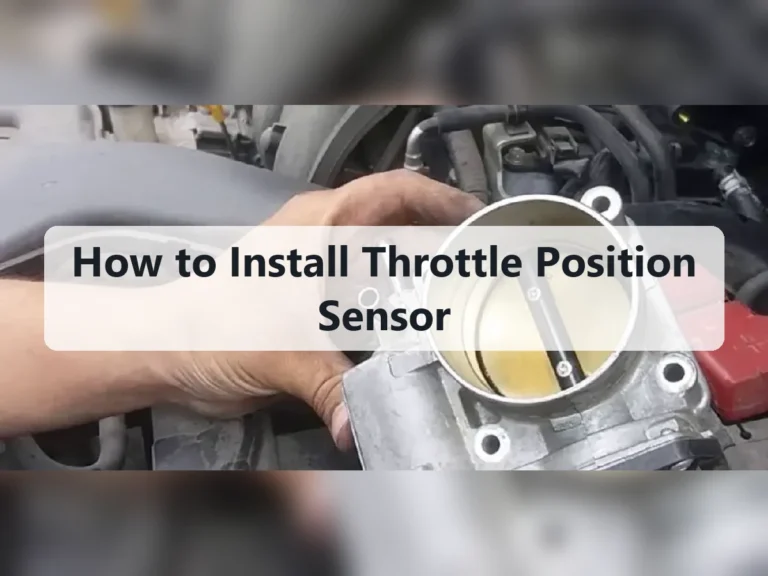
With the engine off, open the hood and find the throttle body. It is usually where the intake tube from the air filter connects to the engine. A throttle position sensor, commonly called a TPS, is mounted on the throttle-body shaft or integrated into the electronic throttle-body housing.
Look for symptoms that fit a throttle-position problem: hesitation during acceleration, an erratic or high idle, reduced-power mode, poor shifting on an automatic transmission, or a check engine light. These clues are useful, but none proves that the TPS is defective. A failing accelerator pedal position sensor can create similar driveability complaints.
Inspect the sensor connector before disconnecting anything. A loose lock, pushed-back terminal, oil contamination, water intrusion, or broken wire near the plug can interrupt the signal. If the sensor is part of a sealed electronic throttle body, note that replacing only the small plastic section may not be possible.
Step 2 Read and record diagnostic trouble codes
Plug an OBD-II scanner into the diagnostic connector, usually below the dashboard near the steering column. Turn the ignition on without starting the engine, follow the scanner prompts, and write down stored and pending codes along with any freeze-frame information.
Codes associated with throttle position or throttle correlation may point toward the TPS circuit, but they are not a final diagnosis. A code can be caused by an open circuit, a short to ground, a missing reference voltage, a poor connector, or a mismatch between the throttle position and accelerator pedal signals.
Do not clear the codes yet. Keeping the original information makes it easier to compare the condition before and after the repair. If the scanner shows several unrelated low-voltage or communication codes, check battery voltage and the main grounds before focusing on the sensor.
Step 3 Inspect the wiring, connector, and throttle body
Turn the ignition off and disconnect the negative battery cable if the vehicle manufacturer permits it for this inspection. Some vehicles may lose radio settings or require an idle or window relearn after battery disconnection, so check the manual first. Never probe a connector by spreading its terminals with a large test lead.
Trace the TPS wiring several inches back from the connector. Look for rubbing against a bracket, melted insulation, rodent damage, corrosion, or a wire that breaks internally where it bends. Examine the throttle body for heavy carbon around the throttle plate.
Deposits can restrict airflow and create an unstable idle, although they do not usually repair a defective electrical signal.
Reconnect a clean, firmly seated connector before electrical testing. A successful inspection means the locking tab is engaged, terminals are not recessed, and the harness is supported rather than stretched. If you find a damaged wire, repair it with an appropriate automotive splice and insulation method before condemning the sensor.
Step 4 Test the reference voltage and sensor ground
Use the wiring diagram to identify the reference-voltage wire, sensor-ground wire, and signal wire. Many TPS circuits use approximately 5 volts as a reference, but the exact value and terminal positions vary. Do not identify wires by color alone because manufacturers reuse colors across different circuits.
With the connector attached or disconnected as specified by the service information, turn the ignition on without starting the engine. Measure between the reference terminal and the sensor ground with the multimeter set to DC volts. A stable value near the specified reference voltage indicates that the control module is supplying the circuit.
Next, check the ground circuit according to the vehicle procedure. A missing or weak ground can make the signal appear incorrect even when the sensor is good. If the reference voltage is absent, or the ground has excessive resistance, stop testing the sensor and diagnose the wiring, power supply, or engine-control-module circuit first.
A useful way to approach how to fix throttle position sensor is to check your progress after each stage.
Important
Do not short the 5-volt reference terminal to battery power or ground. An incorrect connection can damage the engine control module. If you cannot confidently identify the terminals, use a repair manual or have a qualified technician perform the electrical test.
Step 5 Measure the TPS signal through its full range
Back-probe the signal wire with the connector installed, using the correct terminal identification. Turn the ignition on, leave the engine off, and watch the voltage while moving the throttle slowly from fully closed to fully open. On many conventional systems, the signal starts low and rises smoothly toward a higher voltage, but the exact closed and wide-open values are vehicle-specific.
The key observation is a clean, continuous change. The reading should not suddenly drop to zero, jump erratically, freeze, or develop a dead spot as the throttle moves. Move the throttle gradually several times and gently flex the harness near the connector; a signal that changes when the harness moves suggests a wiring or terminal problem.
Electronic throttle bodies may use dual position sensors with two signals that must agree in a particular relationship. In that case, compare both readings with the manufacturer’s specifications rather than applying a simple one-sensor test. An OBD-II scanner displaying live data can help, but a scanner’s percentage reading is not a substitute for knowing the correct circuit values.
Check your result
A useful result is a stable live-data trace or multimeter reading that changes smoothly from closed throttle to open throttle and returns smoothly when released. An intermittent spike or dropout calls for further circuit testing before replacement.
Step 6 Clean the throttle body when deposits are present
If the electrical readings are normal but the throttle plate is visibly dirty, clean the throttle body before replacing the sensor. Remove the intake duct only as far as needed, keep dirt from entering the engine, and use cleaner labeled for throttle bodies. Spray the cleaner onto a cloth rather than flooding the housing or electrical components.
On a cable-operated throttle, the plate can often be moved by hand with the engine off. On an electronic throttle body, do not force the plate against its motor or gears. Follow the manufacturer’s procedure; some allow careful movement by hand, while others require the throttle body to remain undisturbed.
Wipe carbon from the bore and the accessible edge of the plate, then allow the cleaner to evaporate. Reinstall the intake duct without air leaks and make sure every clamp and hose is secure. Cleaning may improve idle quality, but it will not correct a TPS circuit that fails the signal test.
Step 7 Replace the sensor or throttle-body assembly if testing confirms failure
Before buying a part, verify whether the vehicle uses a separate TPS or an integrated electronic throttle body. The replacement must match the exact engine and throttle-body design. Compare the connector, mounting holes, shaft interface, and part number; a visually similar sensor may produce the wrong signal.
Disconnect the battery only if the service procedure calls for it, then unplug the sensor connector. Remove the retaining screws or fasteners without dropping debris into the throttle body. If the sensor engages a shaped throttle shaft, note its orientation and do not twist or force the new part into place.
Install the replacement according to the specified torque and reconnect the plug until its lock clicks. Do not use sealant on an electrical sensor unless the manufacturer specifically requires it. If the TPS is integrated and the procedure requires replacing the complete throttle-body assembly, replace the assembly rather than attempting to separate a sealed unit.
Step 8 Perform the required throttle or idle relearn
Many modern vehicles need a throttle-position or idle-air-volume relearn after battery disconnection, throttle-body replacement, or sensor replacement. The procedure may involve a scan tool, a sequence of ignition cycles, or a controlled idle period. Use the instructions for the exact vehicle instead of assuming a universal pedal-and-key sequence.
Before starting, confirm that the intake duct is sealed, the connector is locked, and no tools remain near the belts or fan. Start the engine and allow it to idle only if the engine responds normally and no severe throttle malfunction is present. A high or unstable idle immediately after service may mean a relearn is incomplete, an intake hose is loose, or an electrical fault remains.
Step 9 Clear the codes and verify the repair on a road test
Once the physical repair and relearn are complete, use the scanner to clear the stored codes. Turn the ignition off, restart the vehicle, and check whether the check engine light returns. Watch live throttle-position data if available and confirm that the reading changes smoothly while the accelerator is applied.
Perform a cautious road test in a safe area with light traffic. Check idle quality, tip-in acceleration, steady-speed operation, and transmission behavior. Avoid aggressive driving until the vehicle responds normally and no warning light or reduced-power message appears.
Understanding how to fix throttle position sensor also means recognizing the limits of the method.
After the road test, scan again for pending codes and review readiness information if an emissions inspection is relevant. A repair is more convincing when the original code stays gone, the symptoms have disappeared, and the sensor signal remains consistent under real operating conditions.
What the Throttle Position Sensor Does
The TPS tells the engine control module how far the throttle is open. The module uses that information to adjust fuel delivery, ignition timing, transmission behavior, idle control, and sometimes cruise-control operation. In older designs, the sensor is often a variable resistor attached to a mechanical throttle shaft.
Newer vehicles generally use an electronic throttle control system. An accelerator pedal position sensor reports pedal movement, an electric motor moves the throttle plate, and one or more position sensors confirm the plate’s actual position. Because these systems include built-in safety checks, a fault may trigger reduced-power mode rather than simply causing a rough idle.

Why cleaning is not the same as repairing
Throttle-body cleaning removes deposits that can restrict airflow around the plate. It does not restore a worn sensor track, repair a broken connector, or correct a missing reference voltage. If the signal has a repeatable dropout during movement, replacement or circuit repair is usually needed.
When a sensor replacement is not the right repair
A problem that appears to be a TPS failure may actually be a damaged harness, poor sensor ground, intake leak, low battery voltage, or accelerator pedal position fault. If several sensors report implausible values at once, consider a shared power or ground problem instead of replacing multiple components.
If the engine races uncontrollably, the throttle sticks open, the vehicle enters reduced-power mode in traffic, or the throttle plate does not respond normally, stop driving and arrange professional diagnosis. Do not continue a road test when throttle control is unpredictable.
How to Judge the Repair
Verification should include both electrical evidence and driving behavior. A code that disappears immediately after clearing is not enough, because the control module may need several operating conditions before it detects an intermittent fault again.

- The connector is locked and the harness is clear of sharp edges, heat, and moving parts.
- The throttle signal changes smoothly without spikes or dropouts.
- The engine starts, idles, and responds to the accelerator without hesitation.
- The check engine light stays off after restarting and completing a cautious road test.
- A follow-up scan shows no returning or pending throttle-related codes.
If the vehicle has an electronic throttle body, verify that both position signals agree as specified. If an idle remains unstable after a successful sensor test, inspect for an intake leak, incorrect relearn, dirty airflow components, or another engine-management issue rather than repeatedly replacing sensors.
Common Problems After Testing or Replacement
Use the symptom as a clue, then return to the circuit and the installation rather than guessing. The compact guide below covers common patterns, but the vehicle’s wiring diagram and service specifications take priority.
| Observed condition | Likely direction to investigate |
|---|---|
| No reference voltage | Power supply, shared 5-volt circuit, wiring, or control-module fault |
| Reference and ground are correct, but signal drops out | TPS, connector terminal, or signal wire |
| Signal is smooth, but idle is poor | Throttle deposits, intake leak, relearn, vacuum system, or another engine fault |
| New code returns immediately | Incorrect part, connector problem, wrong terminal test, or unresolved circuit fault |
There is no change after cleaning
Cleaning cannot correct a failed electrical track or a damaged wire. Recheck the connector and repeat the signal test while moving the throttle slowly. If the signal remains erratic with correct reference voltage and ground, the sensor is a stronger suspect.
The vehicle still has a high idle
Check that the intake tube is fully seated and that every vacuum hose removed during service is connected. On some vehicles, the engine control module must relearn the closed-throttle position or idle airflow after cleaning. A high idle that persists after a correct relearn deserves an intake-leak and engine-control diagnosis.
The replacement sensor does not fit or calibrate
Stop rather than forcing it. Confirm the exact engine, connector style, shaft design, and whether the sensor is sold separately for that throttle body. A part that fits physically but has a different electrical range can create new correlation codes.
Throttle Position Sensor FAQs
These answers address common beginner questions that come up before and after the repair. The exact specifications and relearn requirements still depend on the vehicle.
Can I drive with a bad throttle position sensor?
It may be possible, but it is not reliably safe. A faulty TPS can cause hesitation, unexpected shifting, stalling, or reduced-power operation. If throttle response is unpredictable or the vehicle will not maintain safe speed, stop driving and have it diagnosed.
Can I fix a throttle position sensor without replacing it?
Sometimes. Cleaning the throttle body can address deposits, and repairing a damaged wire or loose terminal can restore a good sensor signal. A sensor with an internal dead spot or intermittent electrical failure generally needs replacement.
Do I need a scan tool to replace a TPS?
Not always for the physical replacement, but a scanner is highly useful for confirming codes, viewing live data, clearing faults, and completing a required relearn. Some vehicles require a capable scan tool to initialize an electronic throttle body.
Should I disconnect the battery before testing the sensor?
Disconnect the battery for physical work only when the service instructions call for it. Voltage and signal tests usually require the circuit energized, so disconnecting the battery would prevent those measurements. Battery disconnection can also erase learned settings.
Why did the check engine light return after replacement?
The original cause may still be present, such as a wiring fault, bad ground, incorrect part, intake leak, or failed accelerator pedal sensor. Scan the returning code, verify the reference and signal circuits, and confirm that the required relearn was completed.
Conclusion
Learning how to fix throttle position sensor problems starts with proving what has failed. Inspect the connector and wiring, confirm the reference voltage and ground, watch the signal for smooth movement, and clean the throttle body only when deposits are part of the problem. Replace a separate sensor only when its circuit and signal show a genuine fault, and replace an integrated throttle-body assembly when the design requires it.
After the repair, complete the vehicle-specific relearn, clear the codes, and verify the result with a cautious road test and a second scan. If the throttle remains unpredictable, the fault returns, or the circuit measurements do not make sense, stop driving and seek qualified diagnosis rather than installing more parts.