How to Tell If Throttle Position Sensor Is Bad: Safe Tests Now
A throttle position sensor can fail in ways that feel a lot like other engine problems. A hesitation when you press the gas, an unstable idle, poor shifting, or a check-engine light may point to the TPS, but they can also come from a vacuum leak, wiring fault, dirty throttle body, fuel problem, or accelerator pedal sensor. Replacing the first part that seems suspicious is an easy way to spend money without fixing the fault.
The good news is that a beginner can perform several useful checks before buying a sensor. You can compare the vehicle’s symptoms with stored diagnostic codes, inspect the connector and wiring, and watch the sensor signal with a scan tool or multimeter. These tests do not require guessing, although the exact voltage range and testing procedure vary by vehicle.
This guide explains how to tell if throttle position sensor is bad while keeping the diagnosis safe and realistic. You will learn how to prepare the vehicle, check for related causes, test the signal, interpret the results, and decide when the evidence is strong enough to replace the sensor or ask a qualified technician for help.
At a glance
- A trouble code by itself does not prove the TPS has failed; wiring, throttle-body problems, and a weak reference voltage can trigger similar codes.
- A healthy sensor usually produces a smooth, uninterrupted signal as the throttle moves from closed to open.
- Do not force an electronic throttle plate or probe wiring carelessly; use the vehicle’s service information when the test procedure is unclear.
How to Tell If Throttle Position Sensor Is Bad: A Safe Testing Method
The most dependable approach is to move from simple observations to electrical testing. Start by confirming the complaint and recording any diagnostic trouble codes, then inspect the sensor circuit before measuring its signal. Only after those checks should you condemn the sensor itself.
Tools you will need
- An OBD-II scanner, if available, to read stored and pending engine-control codes and view live throttle data
- A digital multimeter with voltage and resistance functions for circuit checks
- Vehicle-specific service information, especially the wiring diagram, pin identification, and specified sensor voltage
- Back-probe leads or thin test probes, used carefully without damaging the connector
- Optional: a flashlight and electrical-contact cleaner for inspecting the connector and nearby wiring

Step 1 Confirm the symptoms and make the vehicle safe
Write down exactly what the vehicle does. Note whether the problem occurs during cold starting, warm idling, gentle acceleration, hard acceleration, or gear changes. Also note whether the engine stalls, enters reduced-power mode, or responds poorly only for a moment.
Park on a level surface, set the parking brake, and place the transmission in Park or Neutral as appropriate. Keep loose clothing and tools away from belts, fans, and other moving parts. For basic visual checks, turn the ignition off; for a running voltage test, keep hands and leads clear of the throttle linkage and rotating components.
A useful early observation is whether the engine starts and idles normally but hesitates when the accelerator moves. That pattern can fit a TPS signal problem, but it is not conclusive. If the vehicle has an electronic throttle and suddenly limits speed or displays a throttle-control warning, avoid driving it in traffic until the cause is understood.
Step 2 Read the diagnostic trouble codes before clearing anything
Connect the OBD-II scanner with the ignition off unless its instructions say otherwise, then turn the ignition on and retrieve stored, pending, and permanent codes. Record the complete code numbers and any freeze-frame information before erasing them. Freeze-frame data shows conditions such as engine speed, load, and temperature when the computer noticed the fault.
Codes in the P0120 through P0124 family commonly relate to the throttle or pedal position sensor circuit, but the exact meaning depends on the vehicle. Some vehicles use multiple sensor tracks inside the throttle body, so a code may identify disagreement between signals rather than a single failed component. A code for low or high input can also result from an open wire, short circuit, poor ground, or missing reference voltage.
Do not treat a code as a command to replace the sensor. For example, a throttle-position code that returns immediately with the connector unplugged may indicate a circuit problem, while a code that appears only during movement may fit an intermittent sensor or damaged wiring.
Step 3 Inspect the throttle body, connector, and wiring
With the ignition off, locate the throttle position sensor. On many vehicles it is attached to the throttle body, but some modern units integrate the sensor into the electronic throttle body and do not provide a separate replaceable sensor. Check the repair information before trying to remove anything.
Look for a loose connector, broken lock tab, bent terminal, pushed-back wire, corrosion, oil contamination, or insulation rubbed through against a bracket. Follow the harness several inches in both directions, especially where it bends near the throttle body. A fault that changes when the harness moves is more likely to be wiring or terminal related than a worn sensor element.
Inspect the throttle body for heavy deposits, but do not force the throttle plate open on an electronic throttle unless the manufacturer specifically permits it. The motor and gears can be damaged, and some vehicles require a throttle-relearn procedure after cleaning or service. Cleaning the bore may help an idle problem, but it does not repair an electrically erratic TPS signal.
Important
Never use an ordinary test light or insert an oversized probe into a sensor connector unless the service information allows it. A short between terminals can damage the engine control module or distort the test result.
Step 4 Verify the sensor has a reference voltage and ground
Most throttle position sensors receive a regulated reference voltage from the engine control module, a ground, and one or more signal wires. The reference is often around 5 volts, but you should use the vehicle’s specification rather than assuming every system is identical.
Identify the terminals from a wiring diagram or reliable service information. Turn the ignition on without starting the engine, set the multimeter to DC volts, and connect the black lead to the sensor ground and the red lead to the reference-voltage terminal. A reading close to the specified reference voltage indicates that the supply is reaching the connector.
A missing or substantially incorrect reading shifts suspicion toward the wiring, a shared sensor circuit, or the control module rather than immediately toward the TPS.
Next, check the sensor ground. The most accurate method is a voltage-drop test with the circuit powered: place one meter lead on the sensor ground terminal and the other on a good battery negative or engine ground while the circuit is active. A very small reading is expected.
A noticeable voltage drop suggests resistance in the ground wire, connector, or ground connection.
Do not rely on resistance testing alone to judge a modern TPS. Some sensors are potentiometers, while others use noncontact electronics. Resistance readings can mislead you, and testing continuity on a powered circuit can damage a meter fuse or a module.
A useful way to approach how to tell if throttle position sensor is bad is to check your progress after each stage.
Step 5 Watch the TPS signal while moving the throttle
Back-probe the signal terminal without disconnecting the sensor, connect the meter’s black lead to the sensor ground, and keep the ignition on with the engine off. If the service information gives a required closed-throttle and wide-open-throttle voltage, use those numbers. If no specification is available, look for a smooth change rather than relying on a universal number.
Move the throttle slowly from closed to open and then back again. On a conventional variable-resistance sensor, the signal often starts low and rises steadily, although some designs use the opposite direction. The critical observation is continuity: the reading should not suddenly drop out, jump sharply, freeze, or return to an unrelated value at one particular throttle position.
Repeat the movement several times while watching the meter. An analog meter can sometimes make brief dropouts easier to see because the needle visibly flickers, but a digital meter is more common and still useful. A scan tool that graphs throttle position can provide an even clearer view of a brief interruption.
If the signal is smooth but the scan tool reports disagreement between throttle signals, compare the sensor tracks using live data and the manufacturer’s expected relationship. On electronic throttle bodies, two internal signals are often designed to move in coordinated but different ranges. One track may not match the other even when a basic single-wire test appears normal.
Check your result
A strong sensor test shows a stable supply and ground plus a signal that changes smoothly through the entire throttle range. A sudden open circuit, spike, dead spot, or repeated dropout at the same position is meaningful evidence of a sensor or throttle-body fault.
Step 6 Test for an intermittent fault under realistic conditions
If the signal appears normal while the harness is still, gently move the wiring near the connector while watching the meter or scan-tool graph. Do not pull hard or bend the terminals. If the signal changes when the harness moves, turn the ignition off and repair the damaged wire or terminal before replacing the sensor.
Some faults occur only with vibration, heat, or the engine running. If the vehicle can be operated safely and the service information supports it, compare live data during a short, controlled test drive away from traffic. A passenger should operate the scanner; never handle a scan tool while driving.
Record whether the symptom occurs at a repeatable throttle angle or under a particular temperature or load. A repeatable dead spot strongly supports an intermittent sensor element, while a problem that appears randomly with no signal disturbance may require broader diagnosis of fuel delivery, ignition, air leaks, or the electronic throttle system.
Step 7 Compare the evidence and decide on the next repair
Replace or service the TPS only when the test results support that conclusion and the component is separately replaceable. Strong evidence includes a correct reference voltage and ground, an abnormal signal that changes incorrectly with throttle movement, or a sensor-specific fault that returns after the circuit has passed inspection.
If the reference voltage is absent, repair the circuit or investigate other sensors sharing that reference before installing a new part. If the ground is poor, correct the ground path. If the signal problem disappears when the harness is moved or the connector is secured, the connector or wiring is the more likely repair.
After a replacement, follow the vehicle’s specified installation and relearn procedure. Some systems learn closed-throttle position automatically; others require a scan tool or a prescribed ignition sequence. Do not assume that disconnecting the battery completes the relearn, and do not erase codes until you have recorded them.
What the Throttle Position Sensor Does and Why It Fails
The throttle position sensor tells the engine control module how far the throttle is open. The computer uses that information with airflow, engine speed, temperature, and other inputs to calculate fuel delivery, ignition timing, idle control, transmission behavior, and sometimes electronic throttle operation.
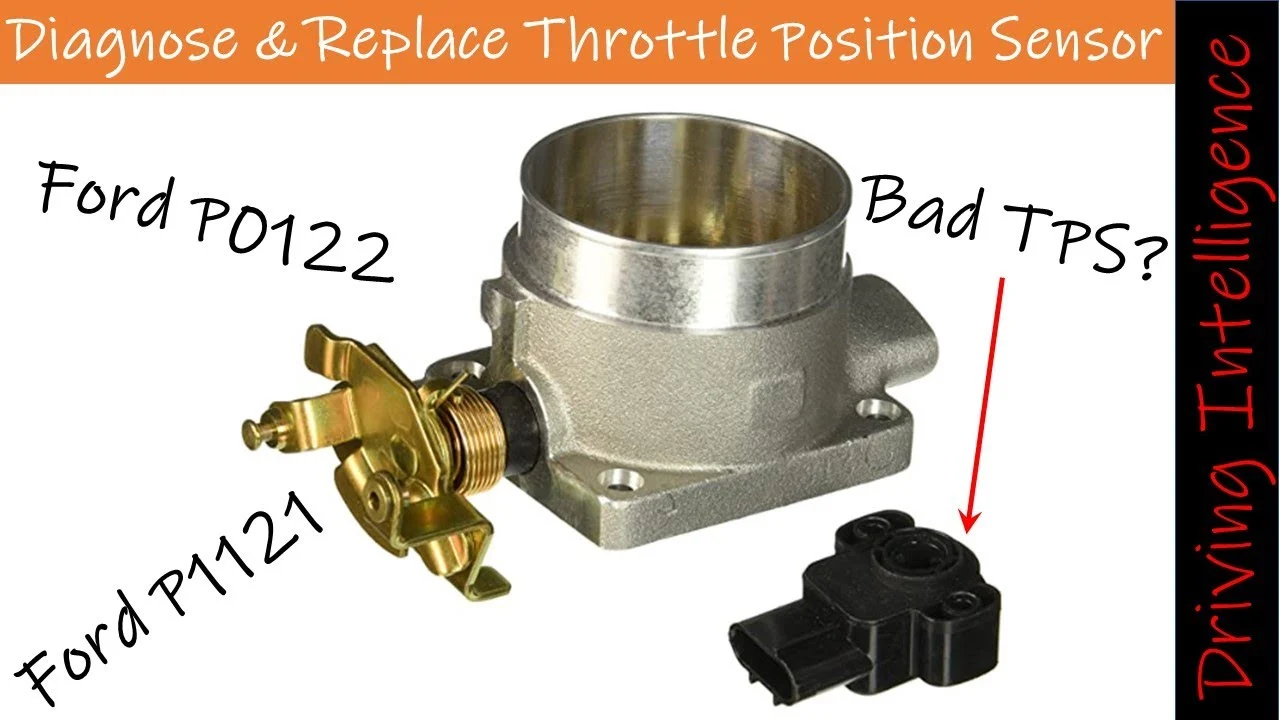
On older throttle bodies, the TPS commonly uses a contact-style potentiometer. A wiper moves across a resistive track, and wear can create a dead spot in the area used most often during normal driving. Newer electronic throttle bodies may use noncontact sensing and redundant signal tracks, so their diagnosis depends more heavily on scan data and the vehicle’s wiring diagram.
Symptoms that can fit a failing TPS
Common symptoms include hesitation when accelerating, inconsistent response to a small pedal movement, stalling as the throttle closes, an unusually high or unstable idle, and reduced engine power. Automatic transmissions may also shift harshly or at unexpected times because throttle angle helps determine load. Understanding how to tell if throttle position sensor is bad also means recognizing the limits of the method.
These symptoms are clues, not proof. A vacuum leak can create a high or unstable idle, a dirty mass-airflow sensor can cause hesitation, and an accelerator pedal position sensor can cause reduced power on a vehicle with electronic throttle control. The engine control module may also set a throttle code when the real issue is a shared 5-volt reference circuit.
How the TPS differs from the accelerator pedal sensor
The throttle position sensor measures the position of the throttle blade or throttle shaft. The accelerator pedal position sensor measures the driver’s pedal request. In an electronic-throttle vehicle, the computer compares both inputs and commands a motor at the throttle body.
A pedal-sensor fault may produce similar symptoms, including limited power and an unresponsive accelerator. Check the code description and live data for both pedal position and throttle position. If pedal data changes correctly but the commanded and actual throttle positions disagree, attention may shift toward the throttle body, its motor, or its internal position sensors.
How to Interpret the Test Results
The result matters more than any single symptom. A diagnosis is strongest when the code, physical inspection, supply checks, and signal behavior all point in the same direction. When they disagree, pause before replacing a component and return to the wiring diagram and live data.

| Finding | More likely explanation |
|---|---|
| No reference voltage at the TPS | Open circuit, shorted shared sensor circuit, control-module issue, or a problem elsewhere on the reference circuit |
| Reference and ground are good, but signal has a dead spot or jumps | Failing TPS or integrated electronic throttle body |
| Signal changes when the harness is moved | Damaged wire, loose terminal, corrosion, or poor connector fit |
| TPS signal is smooth, but idle is rough | Possible vacuum leak, air-metering issue, ignition problem, dirty throttle body, or another engine fault |
| Pedal and throttle data disagree | Possible pedal sensor, throttle-body sensor, wiring, calibration, or electronic-throttle fault |
Why a normal voltage reading does not always clear the sensor
A meter may show a normal signal at rest while missing a brief interruption during rapid movement. It can also miss a fault that appears only when the sensor is hot or vibrating. That is why slowly sweeping the throttle, repeating the test, and checking live data are more useful than taking one voltage reading.
Some vehicles also use a sensor signal that is intentionally not close to zero at closed throttle or not close to the reference voltage at full throttle. The computer may judge the signal based on a learned range and its relationship with a second track. Use the exact service specification whenever possible.
Troubleshooting Mistakes and Safe Alternatives
Many failed diagnoses come from replacing a part based only on a symptom or code. The following distinctions can prevent unnecessary work and help you know when to stop testing at home.
When cleaning may help, and when it will not
Carbon around the throttle plate can interfere with airflow and cause an unstable idle, especially if the throttle body is already dirty. Cleaning may improve airflow, but it will not fix a worn resistive track, damaged wiring, failed redundant sensor, or missing reference voltage.
Use only a cleaner approved for the vehicle’s throttle body and follow the manufacturer’s instructions. Avoid soaking electronic components, forcing a motorized plate, or scraping delicate surfaces. If the vehicle requires throttle or idle relearning, complete that procedure afterward.
Why clearing the code too early causes confusion
Erasing codes removes freeze-frame information and may reset useful adaptive data. It can also make an intermittent fault harder to reproduce. Record the codes and symptoms first, then clear them only after repairs or when a test procedure specifically calls for it.
When to stop and get qualified help
Ask for professional diagnosis if the vehicle has an electronic throttle warning, stalls in traffic, enters reduced-power mode, or requires module programming or a relearn procedure you cannot perform. Also stop if you cannot identify the terminals confidently, if the wiring diagram is unavailable, or if a test result suggests a control-module fault.
Do not drive a vehicle that cannot respond predictably to the accelerator. A throttle fault can become a safety issue even when the engine still starts and idles.
Frequently Asked Questions
These answers address common beginner questions that come up after the initial checks.
Can I tell if the TPS is bad without a multimeter?
You can gather clues without one by reading codes, watching live data with a scanner, inspecting the connector, and noting whether throttle response is inconsistent. However, a meter or graphing scan tool provides stronger evidence because it can reveal a missing reference voltage, poor ground, or signal dropout.
Will a bad throttle position sensor always turn on the check-engine light?
No. A fault may be intermittent, may not cross the computer’s threshold, or may cause drivability symptoms before a code is stored. Conversely, a check-engine light with a TPS-related code does not prove the sensor itself is defective.
What should the TPS voltage be at idle?
There is no single correct value for every vehicle. Many traditional sensors have a low signal at closed throttle, but the specified range varies, and some systems use different signal designs. Use the vehicle’s service information and focus on a smooth, uninterrupted change across the throttle range.
Can a dirty throttle body cause a TPS code?
It can contribute to an implausible throttle position or airflow condition, particularly on electronic throttle systems, but dirt does not automatically mean the sensor has failed. Inspect and clean only according to the manufacturer’s procedure, then verify whether the code and symptom return.
Should I replace the entire throttle body?
Only if the sensor is integrated into the throttle body or the service information specifies the complete assembly. If the sensor is separately replaceable, confirm the circuit and signal fault first. A new throttle body will not solve a broken wire, poor ground, or shared reference-voltage problem.
Use the Test Results, Not Just the Symptom
Learning how to tell if throttle position sensor is bad means checking the whole circuit rather than guessing from hesitation or a trouble code. Confirm the symptoms, save the codes, inspect the connector and wiring, verify the reference voltage and ground, and watch for a smooth signal as the throttle moves.
A sensor with a repeatable dead spot or dropout, supplied by a sound circuit, is a reasonable replacement candidate. If the readings point to wiring, the pedal sensor, a dirty throttle body, or an electronic-throttle calibration issue, repair that cause instead. When the vehicle behaves unpredictably or the test procedure is uncertain, stop and use qualified help rather than risking a throttle-related safety problem.